
telescopes:telescopes_abroad
Telescopes Abroad
South Africa:
Starting with the directorate of de Sitter observations on request by observatories abroad were pursued. Hertzsprung even demanded such access when he cam to Leyden. Later a major source of observing time was obtained by long term agreements, allowing astronomers to stay for a longer period abroad.
• Due to very close ties with Leiden Observatory in Holland, an agreement of co-operation was reached in 1923 between the Union and Leiden Observatories. Astronomers from each establishment were free to make use of the facilities of the other. Since the night skies in Transvaal were infinitely better than in Holland, the flow of visiting astronomers was virtually one way.
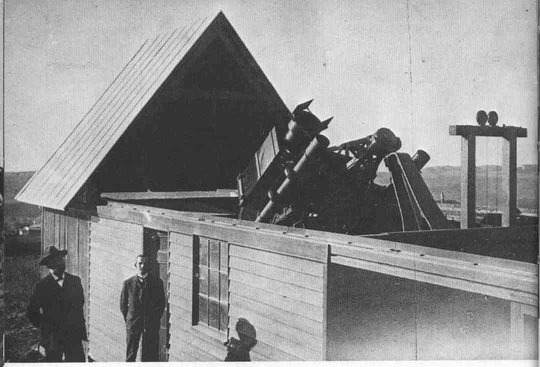
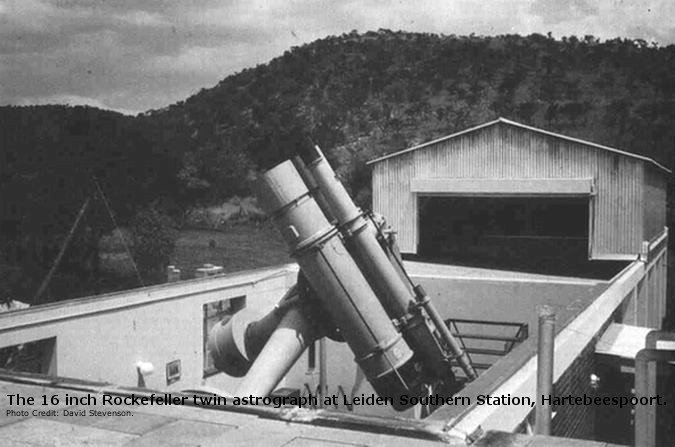
• By 1929 Leiden Observatory decided to send a telescope and permanent staff to Union Observatory. The telescope, known as the Rockefeller twin telescope, was only installed in 1938 due to delays. The South African Government provided funds for a building at the Union Observatory to house the Rockefeller telescope. The first astronomer was Ejnar Hertzsprung (Hertzsprung - Russel Diagram)
• Also a 250 mm photographic telescope was available. It was donated by Mr John Franklin-Adams (1843–1912), a wealthy British amateur astronomer who had conducted a photographic survey of the southern sky at the Cape in 1903.
• The Leiden Observers were concentrating on variable stars. By 1957 they had accumulated 12 000 photographic plates taken at the Union Observatory.
• With the growing light pollution problem in Johannesburg it was decided in 1954 to establish an outstation at Hartebeespoort. This became known as the Leiden Southern Station.
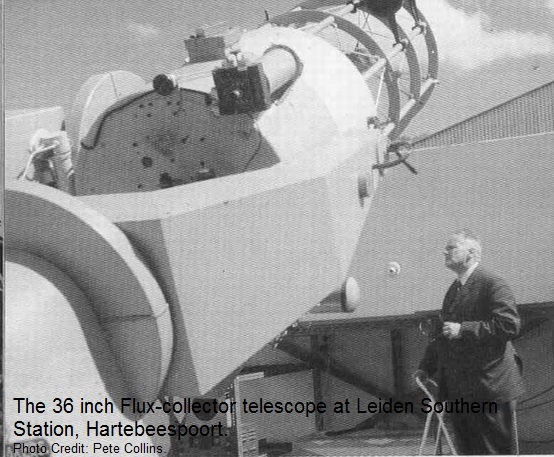
• By the time of the move to the Hartebeespoort the Flux Collector telescope arrived and was installed at Hartebeespoort. The 90 cm Light collector was the first fully automated telescope (what we call today a Go To Telescope) in Southern Africa. Due to continuing light pollution problems this telescope was moved in 19781) to La Silla in Chile.
• After the Republic Observatory closed down, the Leiden Southern station continued to operate until it was sold to Pretoria Technikon.

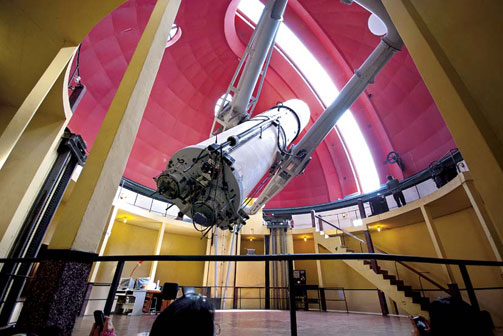
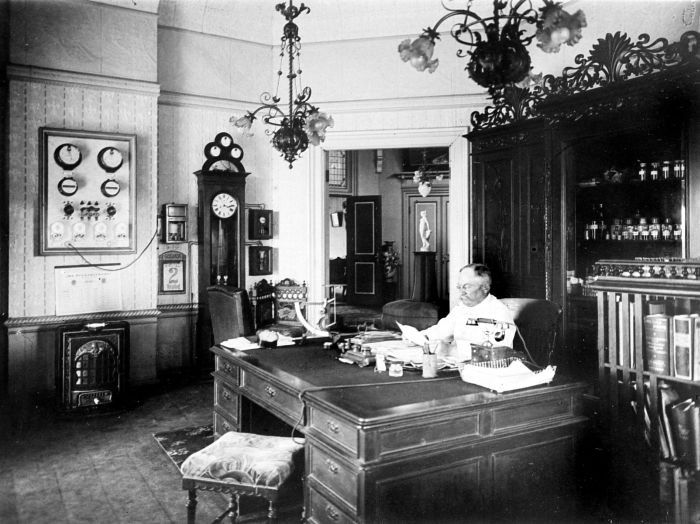 A second agreement was made with teh Bosscha observatory near Bandung. This was originally a fully private funded establishment, paid for by the wealthy K.A.R. Bosscha, who was member of an influential family with close ties to the university enviroment. The telescopes were huge for the time. In the beginning Leyden Observatory basically boycotted the Bosscha observatory. Later better relations were established. One of the directors was the son of de Sitter. He arrived shortly before the second world war, which he did not survive. After the colonial war, and subsequent independence of Indonesia the Bosscha Observatory was taken over bij the Bandung Technical Institute.
La Palma (Canary islands), on the “Observatorio Roque de los Muchachos”:
Dutch Open Telescope (DOT):: a 45 cm reflector for solar observations, with a resolution of 0.22”.
Isaac Newton Group of Telescopes (ING):
4.2-m William Herschel Telescope (WHT) (1987), 2.5-m Isaac Newton Telescope (INT) (1984) and originally also the 1.0-m Jacobus Kapteyn Telescope (JKT).
The ING is operated on behalf of the UK Science and Technology Facilities Council (STFC), the Nederlanse Organisatie voor Wetenschappelijk Onderzoek (NWO), and the Instituto de Astrofísica de Canarias (IAC).
Gran Telescopio Canarias (GTC): (2009) with a segmented 10.4 m mirror. Initiative of Instituto de Astrofísica de Canarias (IAC).
European Southern Observatory (ESO, 1962): The ESO is a 15-nation intergovernmental research organization for astronomy, which provides astronomers research facilities and access to the southern sky. The organization employs about 730 staff members and receives annual member state contributions of approximately €143 million. Its observatories are located in northern Chile.
Telescopes include the New Technology Telescope (NTT, 1989) (which pioneered active optics technology), an Alt-Az, 3.58-metre Richey-Chretien telescope, and the Very Large Telescope (VLT), which consists of four 8-metre-class telescopes and four 1.8-metre auxiliary telescopes.
ALMA (March 2013) is a facility for observation of the universe in the mm and sub-mm wavelength ranges. The ALMA project is an international collaboration by Europe (represented by ESO), East Asia, North America and Chile.
The E-ELT (definition started 2005) is a 40-metre class telescope in the detailed design phase, and will be the world's largest optical near-infrared telescope.
1)
Article describing the moving and specs of the telescope
telescopes/telescopes_abroad.txt · Last modified: by 127.0.0.1