
Table of Contents
Astrograph ("Fotograaf")
Short facts

- Arrived in 1898
- Largest refracting telescope in the Netherlands
- Telescope was built by Gautier
- Lenses were manufactured by the French Henry brothers
- It has an English mount
- Location: 52° 9’ 21” North, 4° 29’ 7” East
- Meant for measuring parallaxes en proper motions
The astrograph consist of three telescopes, the main telescope andthe guidescope which are contained in the rectangular tube and the finderscope that is attached to the outside.
Main telescope
- Focal length: 524 cm
- Lens diameter: 13 inch / 34 cm
- Limiting magnitude: 13 (10 minute exposure)
- Scale on photographic plate: 1 mm = 39,5''
Guidescope
- Focal length: 524 cm
- Lens diameter: 18 cm
- Field of view: 15'
Finderscope
History
Astrophotography
At the end of the 19th century astrophotography was developing very quickly. The first known attempt at astronomical photography was by Louis Jacques Mandé Daguerre who attempted to photograph the moon in 1839. However, because of tracking errors, his image came out as fuzzy and indistinct. The first succesfull picture was taken by John William Draper, a professor of Chemistry, physician and scientific experimenter at the New York University in 1840, when he took a picture of the moon. They were both daguerrotype images which were images made on a silver-plated sheet of copper treated with fumes to make its surface light sensitive. In the years that followed, pictures were taken of the Sun, a star and also the first photographic spectrogram of a star (Vega) was obtained, showing its absorption lines (for more information see astrophotography. However, astronomical photography did not become a serious research tool until the late 19th centure with the introduction of dry plate photography. Stars that were invisible to the human eye, even when looking through a telescope, were made visible in photographs for the first time in 1883.
Carte du Ciel
In 1887 there was an international conference in Paris about mapping the sky photographically. The project was called "Carte du Ciel", or map of the sky. All participants were going to work with the same type of telescope. In total they distributed 13 of these telescopes to for example Algeria, Argentina, Austria, Paris and the Vatican.
H.G. van de Sande Bakhuyzen wanted to have a photographic telescope in Leiden. Not to participate in the “Carte du Ciel”, but to start his own program on measuring the parallaxes of stars. Instead of an instrument with an aperture of 33cm and a focal length of 340cm which were the instruments that were used for the Carte du Ciel project, he choose a telescope with a lens diameter of 34cm and a focal length of 524cm. This was better for the measurement of parallaxes on photographic glass plates because it increased the scale on the photographic plate from 1mm = 60“ to 1mm = 39,5”. The instrument was manufactured by Paul Ferdinand Gautier in Paris and the lenses were made by the brothers Paul Pierre Henry and Mathieu Prosper Henry.
In 1898 the telescope arrived in Leiden. It was placed in a dome that was build between 1896 and 1898 which also housed a dark room used for developing the photographic plates. In 1960 the dome was replaced by a newer one which was build 30 meters west of the old one. The reason for this is probably that the back then newly build Klaauw labratory (which does not exist anymore) was in the field of view of the astrograph. Appearantly, prof. dr. J.H. Oort really hated this. However, it is still not clear, why they moved the dome because in 1960 the glory days of this telescope were over and the moving of the dome was very expensive. In 2011 (?) it would be moved again to its current spot to make way for the houses that were build to fund the renovation of the observatory.
The first years the telescope was mainly used by J.H. Wilterdink who developed a trackingsystem for the telescope. Unfortunately, in the 18 years that he worked on the telescope, he did not do any useful research.
The Fotograaf was used mostly for observing binaries and proper motions of stars.Example paper that uses data taken with the Fotograaf and the gratings. A paper by Hertzsprung on the gratings. Another paper that describes work on minor planets.
Grating
[ ][
][ ][
][ ]
]
Fotograaf toren
The original tower for the Fotograaf was built in 1897. In 1957 it moved to its current place because a new office building had to be built on its old place. This new building was the “Astrogebouw”, the astro building, where the astrophysical department was housed.
On the ground floor of the building is the dark room for developing photographic plates. On the first floor is the telescope.
Stories
In March 1955 the 13 inch was used with a photometer and a polaroid filter by Walraven and Oort to measure the polarisation of the Crab nebula. This data produced a very impressive paper.
Original paper from 1956
Myths
Telescope instruction
USING THE 13" ASTROGRAPH
Entrance
Typically, one arrives at the Observatory in the evening or at night. The dark room is locked by default, to prevent people from entering during tours. The key is in the drawer in the small table next to the stairs, in the dome. To the left of the main entrance to the telescope is the main switch for the dome engines, the driving engine for the hour angle and the sockets on the southern base. As such, the power can be cut with certainty on everything that moves.
In idle position
- Plastic cover on the lenses to counter dust (very important!)
- Aluminium cover on the plate holder side, also to counter dust
- Telescope pointing towards the north.
- Declination-axis in the meridian plane (6h hour angle position: finderscope on the west side)
- Hour-axis and declination-axis: do not lock these!
Tracking engine
The tracking engine is modernised with a FS2 system of Astro Electronic. Only the hour-axis is driven. However, the driving is suitable for a push-to or go-to. By switching on the stepping motor drive the engine will be powered. Lock the telescope only at the very last moment to the driving mechanism. With the remote control the fine tuning of the hour angle can be done with the O (east) and W (west) buttons. The speed of the fine tuning can be selected with the shift-N or shift-Z buttons.
ALWAYS switch off the engine when you're done with your observations!
Objective
- Pull the telescope down gently at the side of the objective, using the rope. Do not be too fierce, otherwise the telescope might hit the buffers with a significant bump, which is very bad for the allignment of the objective parts and the declination-axis. Never wipe the lenses! The lenses are continuously warmed to prevent dew from settling on them; the switch on the northwesternside of the northern pijler (??) must therefore be switched on at all times.
- There is a possibility to put an grating in front of the objective with two bolts. This is only of historical interest and should only be done with someone who has experience doing it. Put the grating on in such away that the dispersion will occur in the direction of the hour angle.
Gratings
The gratings were introduced by Herzsprung to do photographic photometry with. The second-order images next to stars have a very accurate difference in magnitude with the 0th order, which allows one to determine the magnitude scale of the photographic plate very accurately. Nowadays this is not used anymore.
Counter weights
Sometimes it's necessary to put counterweights on the telescope to balance additional equipment put on the telescope. For short times with light-weight equipment it is not necessary; the telescope can endure some imbalance.
Plate holders
These were used to hold the 16×16 cm photographic glass plate. We don't use this anymore nowadays.
Eyepieces
The tracking telescope has a fixed eyepiece.
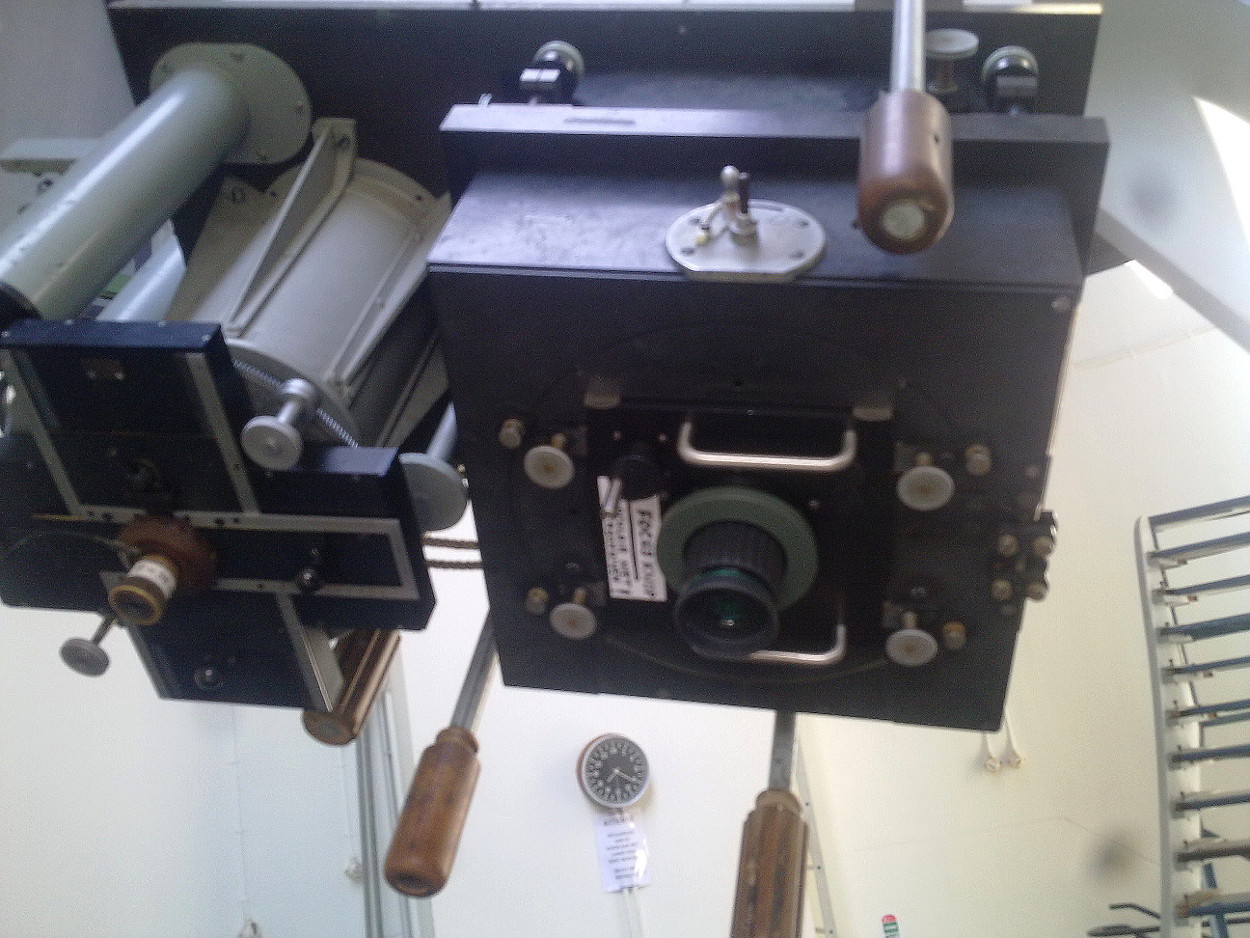 The main telescope of the Photographer can be used for visual observations since 2013. The eyepiece of the main telescope is semi-fixed; it can be taken out, with a great deal of effort, and should only be done by very experienced people.
In one of the boxes are additional eyepieces. In the telescope is always an old eyepiece for sealing purposes and to show the moon during the day with tours. This eyepiece is sufficient for that purpose. That's all that can be shown, since Earth's horizon is far beneath the edge of the dome. For observing the firmament, the following eyepieces are present:
The main telescope of the Photographer can be used for visual observations since 2013. The eyepiece of the main telescope is semi-fixed; it can be taken out, with a great deal of effort, and should only be done by very experienced people.
In one of the boxes are additional eyepieces. In the telescope is always an old eyepiece for sealing purposes and to show the moon during the day with tours. This eyepiece is sufficient for that purpose. That's all that can be shown, since Earth's horizon is far beneath the edge of the dome. For observing the firmament, the following eyepieces are present:
| F | Model | Vergroting |
|---|---|---|
| 36 mm | Baader Hyperion | 146x |
| 22 mm | TS Expanse | 238x |
| 17 mm | TS Expanse | 308x |
There are for all scopes more eyepieces available, as well as filters for the specialists.
Webcam
There's a webcam-laptop holder which can be put in place of the plateholder. This will be available for general use in a later stage. N.B. since a fixed eyepiece was put in the main scope in 2013, using a webcam or another camera in its place is not trivial
Coordinates
- Set the hour circle on the siderial tiem, on a fixed index.
- Set the moving zero of the vernier on the right ascension of the object.
- Set the pole distance of the object to the middle of the vernier zero. (?)
- Locking of the hour-angle is at the edge of the hour circle. Accuracy to about 10 sec. Declination-axis locking is at the eyepiece-end. Accuracy about .5'.
- To check all this, fix on a bright star from the computer list; this star must be in the middle of the eyepiece, if the eyepiece is on the coordinates plm 50-50.
Exposure time/digital imaging
Photos can be made by setting up the coordinates, and tracking a sufficiently bright star with the tracking scope, on the intersection of the crosshairs. The scope is re-balanced, because it was only well-balanced with a rather heavy plate holder, which is not used anymore.
Observation journal
Write with every observation the relevant information in the observation journal. The temperature can be read off of the thermometer on the side of the telescope. Also, relevant striking circumstances found at entry of the dome should be noted (e.g. if the telescope was not stored properly by the previous user).
Closing the dome
If the power falls away, the dome can be closed by hand. To do this, on top of the engine (on the lower side of the dome opening) there is a handwheel. Because of the big delay in the transmission of the movement to the shutters, one must expect to rotate this wheel for 15 minutes. First, turn the power off; if the engine would restart unexpectedly, you could fall nastily from the shock.
Checklist when leaving the photographic telescope:
- Declination-axis in meridian plane (vertical position)
- Curtains in front of the lenses are closed. Cap on the finderscope.
- Loosen the clamping on the hour- and declination-axis.
- Switch the scope lighting off (on the panel on the tracking scope)
- Close the shutter on the photographic scope
- Dome and shutter dome-opening switches in neutral position
- Main switch of the dome/dome-opening, on 'off'.
- Door to the balustrade closed
- Outside-lighting 'off'
- Lighting on siderial-time circle 'off'
- Dome lights 'off'
- If used: Dark-room lighting off.
- Close doors to the dark room and the dome.
- Switch off the main-switch next to the main entrance.
The dome
The telescope is mounted on an English mount. this means it hangs in the frame which is supported by two columns, one on the north side and one on the south side. This as opposed to the German mount of both the 6- and 10 inch telescopes. The northern column has stairs just in case, but is for maintenance so it's recommend to not use it. On the south side there's the engine, among other things. The engines and dome opening have fuses and RCD (K2) in the closet next to the main entrance, downstairs. Because these overturn every once in a while for no apparent reason, they've been marked clearly. Put them back and check if the problem has been solved.
Electricity
| Group | Connection(s) |
|---|---|
| 1 | Verlichting 1e verdieping en omloop |
| 2 | Boiler doka |
| 3 | Stopcontacten doka (incl. elctr. Verwarming) |
| Stopcontact volgmotor 1e verd. + hoofdschakelaar naast de voordeur | |
| 4 | Verlichting BG |
| 5+6 | Elec. Verwarming |
| 7 | Stopcontacten werkplekken doka en 1e verd. |
| 8 | Reserve |
| K1 | Stopcontact 380V + hoofdschakelaar naast de voordeur |
| K2 | Motoren koepel en schuif + hoofdschakelaar naast de voordeur |
| K3+K4 | Reserve |
| ST | Stuurstoom relais |
| HS | Hoofdschakelaar |
| OSD | Bliksem beveiliging |
Het plafondlicht boven de trap is hotel-geschakeld boven en onder aan de trap. De plafondverlichting in de doka is hotel-geschakeld bij de deur en daartegenover. Deze merkwaardige schakeling voorkomt dat bij de deur per ongeluk het toplicht aangedaan wordt, waardoor onontwikkelde platen verknoeid kunnen worden; historisch dus. Op de 1e verdieping links naast de Zuid-voet zit de schakelaar die de laanverlichting uit laat gaan. Links naast de Noord-voet zit een schakelaar die er uit ziet als een lichtschakelaar maar die de objectief verwarming bedient. Niet aankomen. Op de Noordvoet staat de transformator die de kijker via sleepcontacten 25V (lensverwarming) en 6V (lampjes) levert. De koepelmotoren zijn uit te zetten met de hoofdschakelaar op schakelkast en met de hoofdschakelaar naast de voordeur, dubbelop dus.
Afstandsbediening - Astro Electronic FS2 (V1.21)
 Symbolen display rechts onder
| _ | Coördinaten onjuist omdat nog geen oplijning met referentie sterren is gedaan. |
|---|---|
| M | Coördinaten brekend uit de positie van de stappenmotoren |
| E | Coördinaten berekend met de encoders |
Veranderen slewing snelheid
| Shift-N | ga naar de volgende hogere slewing snelheid (die snelheid wordt even getoond) |
|---|---|
| Shift-Z | ga naar de volgende lagere slewing snelheid (die snelheid wordt even getoond) |
| Shift-O | ga cyclisch naar de volgende soort volgsnelheid |
Cyclische keuzen volgsnelheid:
| Maan | Gemiddelde maansnelheid 52m 42s /dag |
| Zon | Gemiddelde zonsnelheid 3m 57s /dag |
| Komeet | Programmeerbaar |
| Aarde | Niet volgen bv. voor het instellen van de optiek overdag |
| Siderisch (sterren) | Normale snelheid voor het volgen van de sterrenhemel |
Keuzemenu Shift-W
| 3.1 | Ref. Obj. | Na instellen op een referentie object (heldere ster) pas het coördinaten display aan. |
| 3.2 | Goto | Slew naar (ref.) object |
| 3.3 | P.E.C. | Correctie periodieke fout |
| 3.4 | Brightn. | Pas helderheid display aan met NZ |
| 3.5 | Lamp | Pas flashlight lichtsterkte aan met NZ |
| 3.6 | Spiral | Zoek object in spiraal patroon |
| 3.7 | Low Curr | Energie besparing |
| 3.8 | 5 Rates | Kies één van de vijf instel snelheden |
| 3.9 | Mot_1 Ra | Uurhoek motor |
| 3.10 | Mot_1 De | Declinatie motor |
| 3.11 | Misc. Zie § 3.11 | Komeetvolgen, encoders, teeth: aantal tanden uurhoek tandwiel, toetsen toewijzing, LX200, taal, timer, belichtingstijd |
Toetsen keuze menu
| Toets | Functie(s) |
|---|---|
| N (boven) | - Plus (ophogen waarde) |
| - Volgende menu optie | |
| Z (onder) | |
| - Vorige menu optie | |
| O (links) | Esc (verlaat functie zonder opslaan) |
| W (rechts) | Enter (bevestig huidige functie en sla op) |
| Shift | Flashlight (langer dan 1 sec ingedrukt) |
Gast Modus Druk alle 4 toetsen in. Dit is de toggle voor “Guest mode” aan/uit. Display Indrukken en vasthouden van N vóór het aanzetten van de voeding: display: helderheid maximaal. Rates: 1: 0,25 2: 1 3: 5 4: 25 5:100
Goto objecten
| Messier | Messier catalogus (109 objecten) |
| NGC | NGC objecten tot m = 13,9 (3169 objecten) |
| IC | Selectie IC catalogus (344 objecten) |
| Planet | Zon en 8 planeten |
| Re+De | Input rechte klimming en declinatie |
| Star | Sterren helderder dan m = 3,0 (168 sterren) |