Modeling RSD effects in FLAMINGO
Master Research Project under Dr. Marcel van Daalen
Redshift-Space Distortions (RSDs), such as the Finger of God and the Kaiser effects give a warped view of galactic distances, since we do not accurately know the non-Hubble (i.e. peculiar) velocities of distant galaxies.
In my current project, I am focussing on using the FLAMINGO simulations to create a statistically sound model to describe these peculiar velocities and model the subsequent RSDs.
For this, I am modeling both a "one-halo" term and a "two-halo" term, which is to say the intra-halo motions and inter-halo motions respectively. My work builds directly on the master thesis by Sowmya Parthasarathy.
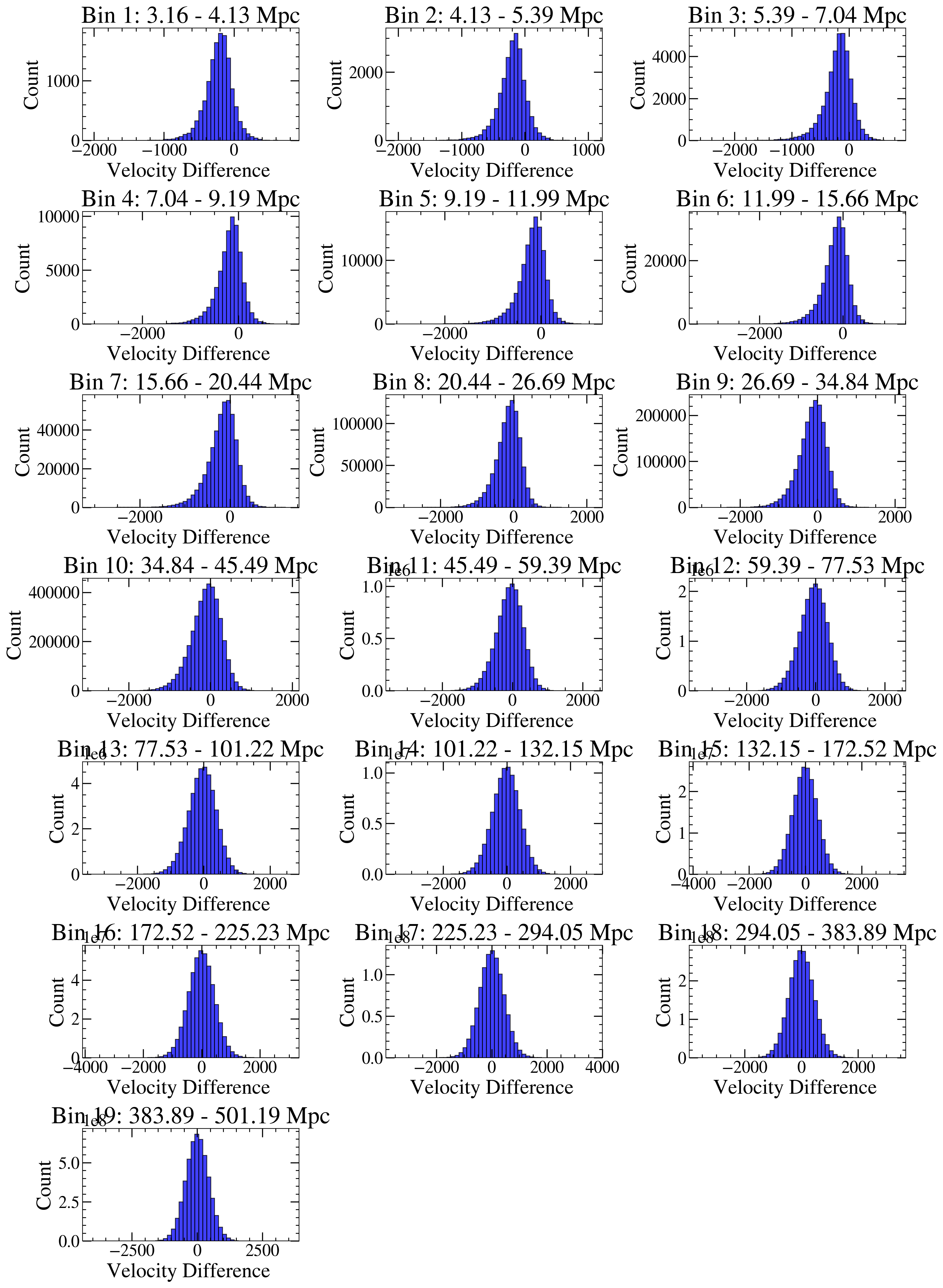
Shown on the left is a figure containing histograms for the velocities of all halo pairs at different radial seperation bins. The halo pair velocities are projected to the line connecting them and are defined to be negative when the haloes move toward each other. The halo pairs, consisting of a primary and secondary, are further selected by having a mass in the range 1012.5-13 MSun for the primary halo and 1013-13.5 MSun for the secondary.
Of particular interest is the non-Gaussian skew and kurtosis at low distance, showing the effect of the gravitional pull these haloes have on each other. The aim of the project is to eventually find a non-binned functional form (i.e. explicit mass and radius dependence) for both this two-halo result and the one-halo velocity distribution.