
My Research
The two projects I worked on for my PhD research are both in the field of massive star formation. Stars more then eight times more massive than our sun provide a challange to observationalists due to their more distant and embedded nature. If we take a step back to an idealised formation scanario for lower mass stars I can explain the problems at hand.
Dense condensates of gas and dust in giant molecular clouds are the starting point of a stars life. Over time these condensates collapse due to gravity and flatten out into a disc configuration, due to rotation, and a central proto-stellar core. Energetic jets and outflows are driven from regions close to the central cores. Due to the abundant nature of solar like protostars and the fact that much of the obscuring material before has been dispursed before the stars begin life on the main sequnce means observations of the formation processes are easily made. The observation of these low mass protostars confirm the idealised formation scenario.
For massive stars however, the formation scenario is more uncertain. These objects are rarer and thereby more distant on average. This means the telescopes, that were adequate to observe low mass stars forming close by, now probe much larger scales and cannot see the massive proto-stars in detail. Furthermore, as massive stars require more material to form from they are found deeply embedded within molecular clouds during the crucial stage we wish to investigate. Their embedded, distant nature coupled with the fact that they take much less time to form and start nuclear burning means they are still embedded when they are born, and become massive stars. This makes the prestellar stages very hard to investigate in enough detail to piece together a formation scenario, and understand their formation.
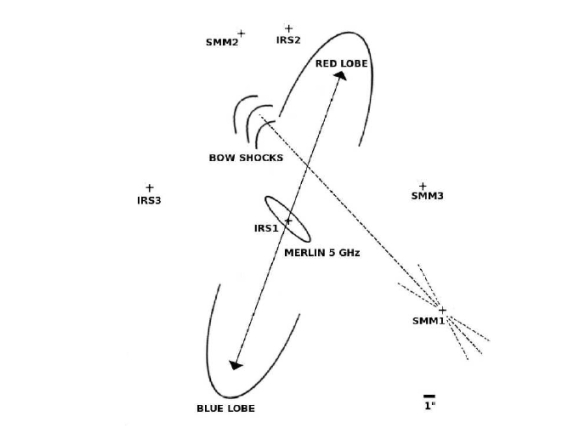
My first project involves the reduction and analysis of interferometric data sets. Using interometers to observe massive young stellar objects (MYSOs) at millimetre wavelengths I can investigate the morphology of the dust emission. In a simplistic sence, by comparing my dust observations with molecular emission from outflows, radio wavelength observations of jets and computational models of the massive protostars natal environment, I can establish whether the dust emission is likely to be from a compact disc. My current work on the source S140-IRS1, a proto-type ionised disc-wind source, suggests there is a few 100 au disc that is perpendicular to the direction of the molecular outflow, in agreement with the general low mass star formation scenario.
Dust emission from discs has only been reported in a handful of massive protostars, however. The these few examples suggest that massive stars form from discs similar to low, solar, mass sources. The kinematic analysis of molecular line emission close to the central source indicates that these structure are rotating. Current facilities such as CARMA and SMA can investigate these molecular lines at sub-arcsecond scales. With ALMA well into cycle 2 observations, high sensitivity observations at sub-arcsecond resolution are routinly undertaken. When more extended configurations are offered, detailed observations of MYSOs with ALMA will provide much more insight to the complex formation regions and could probe milli-arcsecond scales. This is a very exciting time for massive star formation research.
My second project involves the investigation of a large (99 source) sample of MYSOs and HII regions drawn from the the RMS Survey. Emission from the (3-2) transition of Carbon Monoxide has been observed with the JCMT. Such emission from MYSOs can indicate large outflows of material emanating from the central source, much like the outflows driven by low mass stars, but on a much larger scale. Outflow emission can be regarded as indirect evidence of the central star being surrounded by an accretions disc. In comparison to my previous work these observations are of much lower angular resolution, however, the larger sample, rather than a few sources, allows trends to investigated.
Please see my publications for more detailed information.
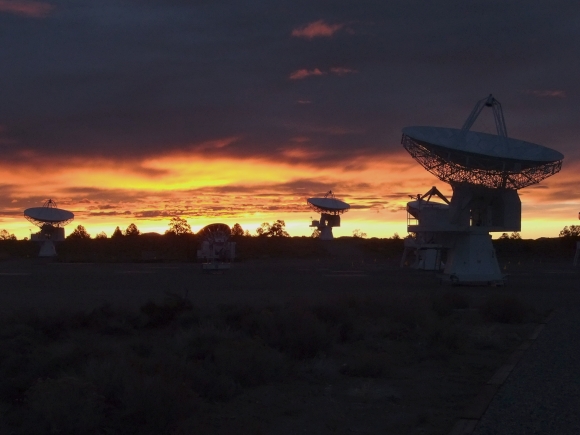
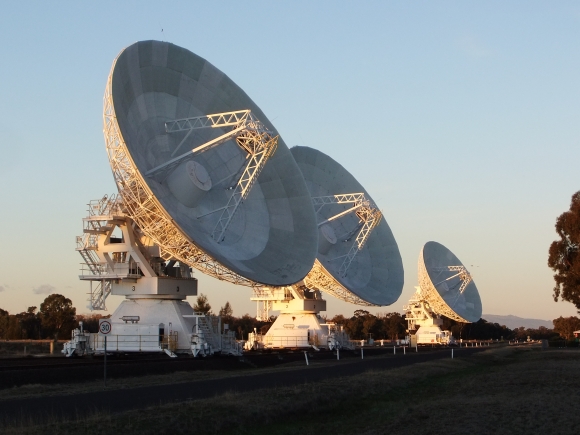
Image Slider: CARMA at sunset / ATCA antennas 1-3 / Schematic of S140 region - Luke T. Maud
Image: Me at 10000 ft elevation in hills surrounding CARMA