Talcott Telescope
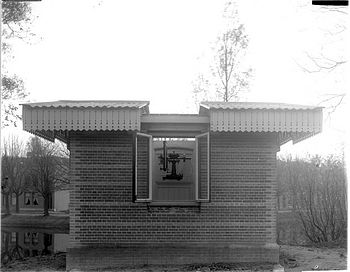
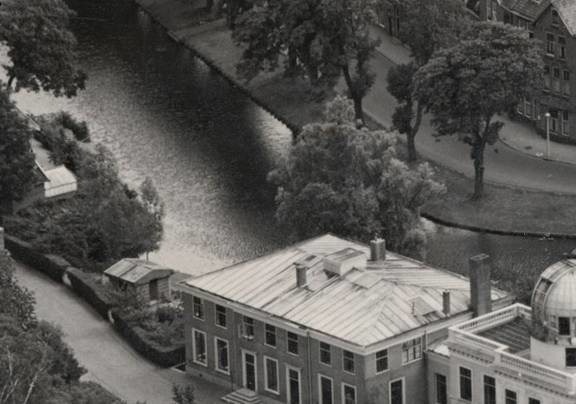
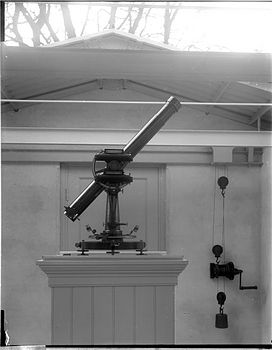 In 1898 the observation hut East of the observatory was specifically build for a telescope1) which should measure with great precision the latitude of the observatory. The polar motion of the Earth was discovered a decade earlier. This motion is the movement of the point where Earth's rotational axis intersects its surface. It consists of two quasi-periodic components and a gradual drift. It amounts to a few 0,1”, but is enough to spoil meridian observations. As it is not well predictable it must be measured.
The method employed was developed in the middle of the 19th century by Andrew Talcott (US). He got the idea from Peder Horrebrows (Denmark), who suggested the method already a century earlier. The successive transit of pairs of well chosen stars(of known position), culminating North and South of the zenith, are observed. The instrument is rotated 180⁰ between the observations, but everything else remains fixed. Many instrumental and atmospheric errors are cancelled by this approach. An systematic international observation network of telescopes was organized in those years and operated for almost a century. Leiden participated for about 10 years.
Stars in the sky which pass not too far overhead are used, hence the name “Zenith-telescope”.
Regrettably a considerable part of the measurements were destroyed in a fire.
The “hut” is used as a coffeeshop for the Hortus Botanicus during the restauration of the observatory.
Clip website "Voor het te laat is."