
Table of Contents
Van der Wall Telescope
[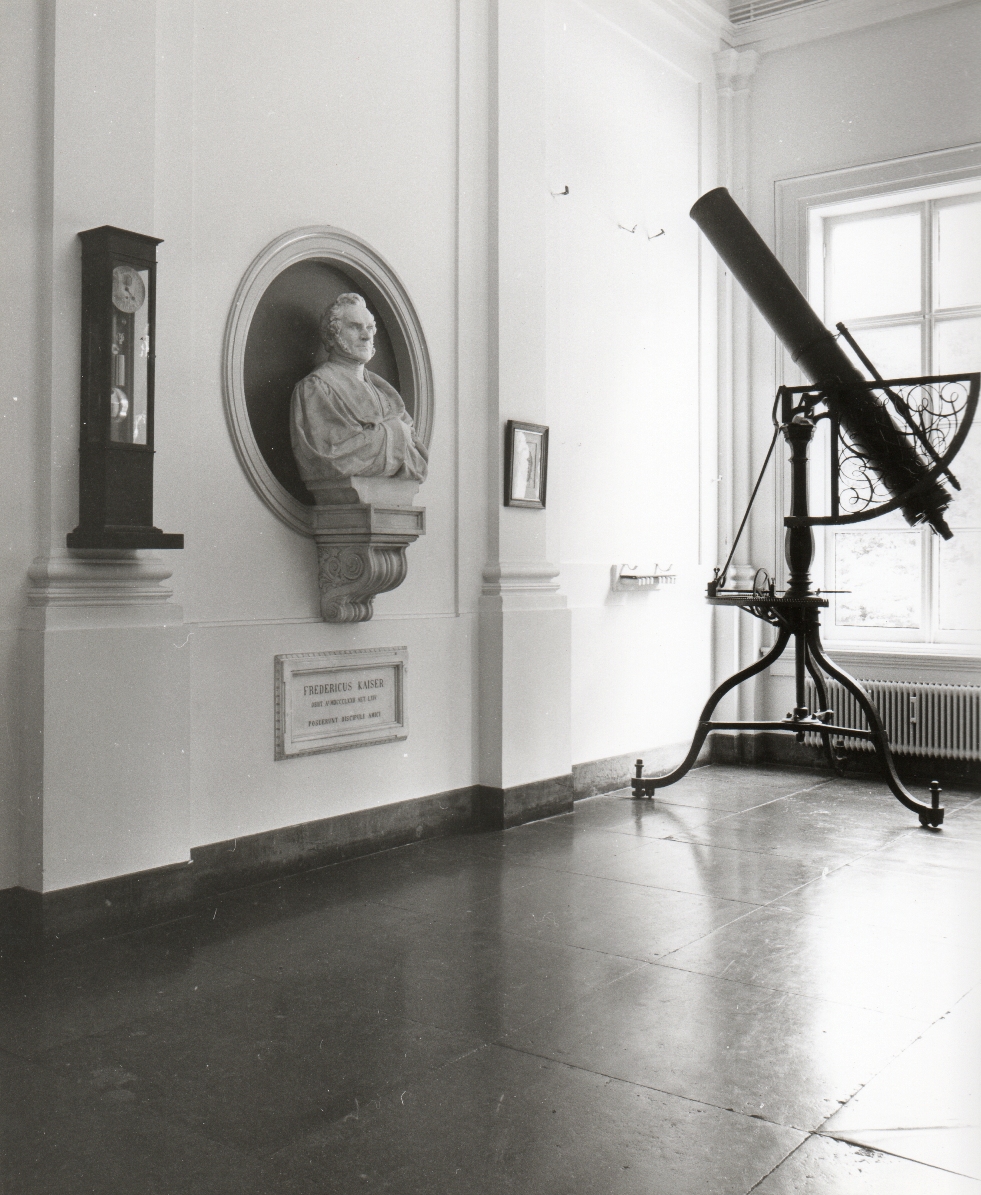 ]
The reflector of Jacobus v.d. Wall which was on display in the Old Observatory, and is again on display in the Oort Building. It is now an ornamental antique, but at it's time in 1742 it was state of the art.[
]
The reflector of Jacobus v.d. Wall which was on display in the Old Observatory, and is again on display in the Oort Building. It is now an ornamental antique, but at it's time in 1742 it was state of the art.[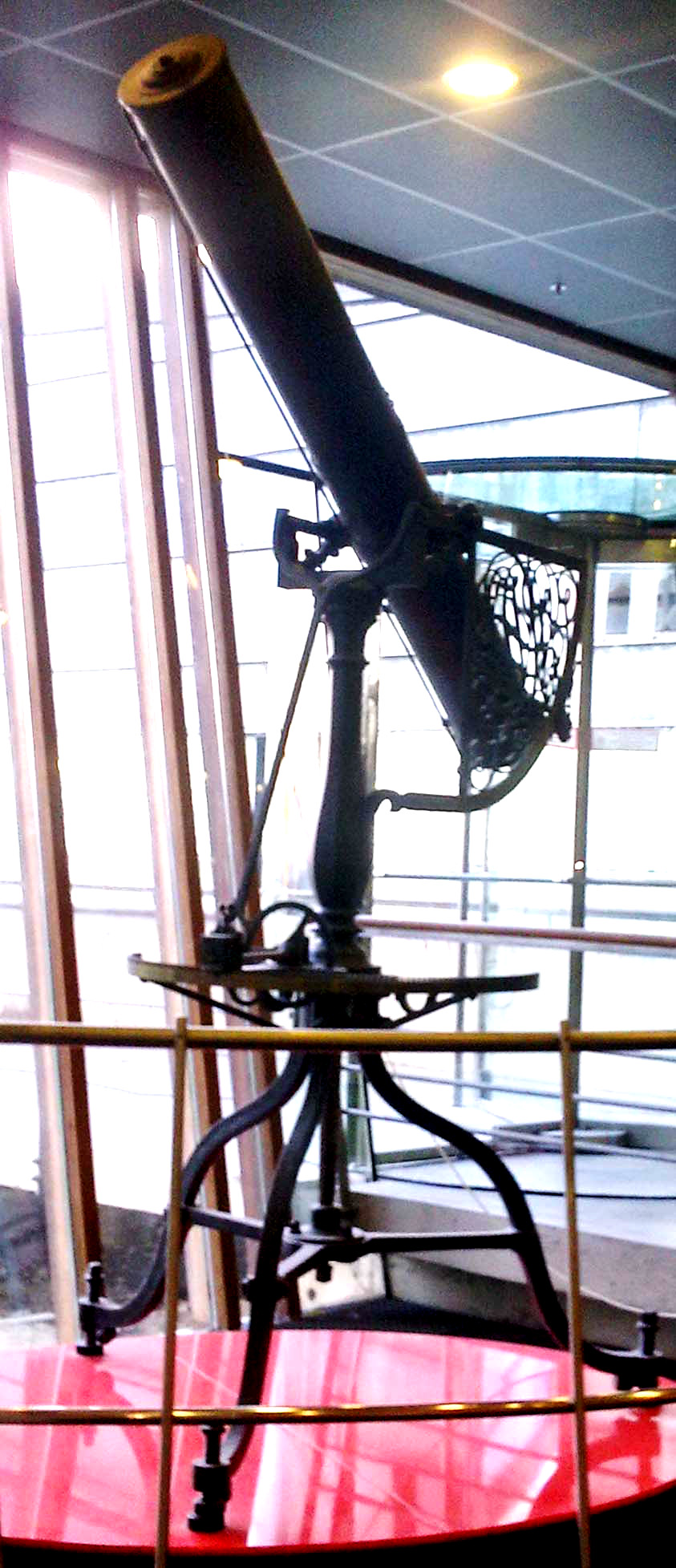 ] Van der Wall was a rich merchant with a keen interest in telescope building and mirror grinding. He installed it in a building at the edge of Amsterdam. However his interest was strictly the astronomical hardware. He was a childless widower1) and generally described as a decent and benevolent man. Though this telescope was reported to be a good instrument, very few observations are known.2)
In a review3) of Huib Zuidevaarts article; “'konstgenoten' en hemelse fenomenen” we can see that the Van der Wall used to be the largest telescope4)) in the world for a short while. Looking back at journals citing dialogues between Van der Wall and visiting astronomers, we read that he told most of them that this telescope was built before James Short built his 12' telescope but after he had made 4' telescopes. Acording to Huib Zuidevaart5), this gives a timewindow of roughly 2 years, as these two events happened between 1741 and the end of 1742.
If this is true, and we do not see reason to doubt Van der Wall's word, the telescope was the largest mirrored telescope in the world for a about a year!
The author believes that because of modesty and the lack of interest to participate in scientific observation caused this telescope to remain unknown for years before word about it spread.
When it was donated to Leyden Observatory in 1772 it was still the largest telescope6) in the Netherlands. If it had been used properly it could have been a match to quite some work by the Herschels.
Note: the letter “W” which adorns the declination arc refers to “Wall”, not to the royal family.
The telescope doesn't have its mirrors anymore. The mirrors were probably lost somewhere in the early 19th century. It is mentioned that the mirrors degraded quite quickly.
Jacobus van de Wall. 1700-1782. w. c.1742. Amsterdam. reflectors. trained by Von Sprögel. a wealthy merchant. the only surviving telescope is a large Gregorian, c1750, speculum cast by Carl Ulrich Bley, ground & polished by Van de Wall, mechanical parts by Adam Steitz of Amsterdam, now exhibited at Leiden New Observatory & Museum Boerhaave. (Zuidervaart, Van Gent)7)
Ferrner's visit 1759
 Bengt Ferrner, a Swedish astronomer, wrote about the Van de Wall Observatory in his diary. He describes how the observatory looked and what it was equipped with in 1759. He constantly misspells his hosts name, which is left in for accuracy.
The relevant diary part8) starts on the 4th of April, when he is invited by Van de Wal to see his observatory.9)
“On the 4th I was invited by Mr. Van de Wal to his observatory just outside of the Leiden Gate in Amsterdam, to see his instruments, particularly his 8 foot telescope. He has made the mirrors himself and set up the plan for the manufacturing of the telescope all its parts. Mr. Lefebure and Mr. Grill accompanied me on this excursion.
After we were received, we went to the observatory, where the aforementioned telescope was housed. It was 8 feet long and its mirror had a diameter of about 11 or 12 thumbs. Apart from the usual construction, this telescope had a small quadrant attached to it so that it was easy to find heavenly bodies when their position is calculated. However, none of the instruments were so precise that the location of the heavenly bodies could be measured with a decent accuracy. The instrument was not very professionally made and lacked a micrometer. The observatory itself was so small, that it seemed to have been built for this instrument alone. Four brick pillars, reaching deep into the ground, carry the floor on which the telescope rests. This construction is inside of a plank house, and the roof is a copper dome that can be rotated in the same manner as a windmill cap. The dome had a slit as wide as the diameter of the telescope, which could be opened and closed easily by use of pulleys. In this manner, the observer could observe any part of the sky by rotating the roof and the telescope. There were also other reflective and refractive telescopes, but our host drew our attention to mirrors that were made for a 20 foot telescope, that, as our host told us, was made because of the following reason. Before he had built his own telescopes, Van de Wal wanted to buy a 4 foot telescope in England, but the price was exceptionally high. Because of this he, being well practised in the theory of optics, decided to make one himself, larger than any telescope in England. When Mr. Short heard of this, he started working on two 12 foot telescopes. Mr. Van de Wal did not want to be outdone by Short, so he started working on the 20 foot telescope. He did not yet have the time to test the mirrors, but they were finished completely.
In the observatory mainly two things lacked, a meridian and a pendulum clock, and there was no room for either. From this I conclude that Mr. van de Wal is mostly interested in observing heavenly bodies and to prove his knowledge of the theory of optics with his telescopes. Lacking interest in doing observations that could serve to improve astronomy. It is clear that he does not have time for such things, as he is a noteworthy merchant in Amsterdam, and spends his days in a big office with his brother. He is a childless widower and posesses several tonnes of gold in Dutch money. He has a good and clear mind and a lot of physical and mathematical knowledge. People believe him to be a well willing and decent person.”
Visit by Bugge 1777
[ ][
][ ]In his diary10) Thomas Bugge, a danish astronomer from the 18th century who visited Van de Wall, describes the observatory of this rich merchant in August 1777. In his journal he is clearly impressed by the work of this man, who in his old age is still very active.
From his diary11): “A French merchant, Peaume, who stayed with me at the Midelste Bijbel, introduced me to a rich merchant, Van de Wall, who lives immediately outside the Leiden gate, he is not only a lover of the sciences, but constructed mathematical instruments himself. In his garden he has built a small observatory, whose roof can rotate on rollers by means of pulleys. The opening in the meridian or Crenae throughout is plane copper plates fitted into grooves, and these copper plates can be hoisted up by means of pulleys. A specially comfortable appliance has been constructed to sit in or lean against when observing in different heights. On the Inner sides of the two S-shaped boards AB and CD, spaced about 3 feet apart, parallel lists have been fixed two by two at intervals of about 5 inches. If boards are placed between these lists, for example in BD, EF or GH, you can easily make observations either sitting or standing.12)
The most remarkable object at this dignified man's house is an 8 foot reflecting telescope constructed by him. It works very well and is of excellent workmanship. I will begin by describing the support, its lower part consists of 4 iron feet DC, CE, FC and CG, fitted with adjusting screws D, E,F and G, these feet are joined at C which is a fixed cylinder, branching off from each of these four feet are horizontal iron bars at H which is placed immediately below the center of the hollow cylinder C. To these feet is also fixed a horizontal half-circle NOP, whose upper edge is toothed and graduated. Nothing more is attached to the feet. On the cylinder of the telescope two pivos have been fixed to the vertical axle BQH, moving in the hollow cylinder QC and in the hole H. Branching off from A is another fork RS, supporting a gearbox S which is furthermore connected with the disk ST. The box S contains a wheelwork which can be pressed down into the teeth of the half circle NOP and be moved by a fine screw. It also has a pointer which marks the degrees on the edge NOP, or indicates the azimuth once the telescope has been placed in the meridian. Furthermore, a quadrant UWX divided in 90 degrees, has been fixed to the vertical axle BTQH. THe edge WX is toothed and meshes into an endless screw a, placed in the box Y. By means of a screw b, these teeth can be made to mensch or not. It is easy to see that the telescope can be carried up and down this quadrant, and the altitude can be measured by means of the quadrant. In order to make this instrument more stable, a wall has been erected which has no connection with the wooden building, on the wall this heavy machine s placed.
Dimensions (Amsterdam measures)
- The large mirror focus = 8 foot
- Diameter of the apature = 9 inches
- Diameter of the hole = 2 5/8 inches
- Focus of he small mirror = 8 inches concave
- Magnification = 300
[ ]Mr. van de Wall maintained to have observed that the rings of Saturn get thinner towards the edges and get thicker towards Saturn. And that Saturn was full of circles parallel to themselves and to the ring. Mr van de Wall also had several smaller telescopes made by himself. He told me that when he heard that Short had constructed a 12 foot telescope, he himself had been constructing one of 18 feet. Its mirror was already completed. But as the other parts of the telescope and especially the support would be too heavy and strong, he had given up the work.
It must be noted that with the great telescope Mr Van de Wall is able to magnify up to 600 times, but then he changes into a cassegainian telescope by changing the focus of the small convex mirror from 6 to 4 inches to see the object in upright position by means of two oculars. Furthermore the air must be extremely pure. Mr van de Wall, who is now in his seventy-seventh year, showed me an excellent piece of flint glass from England. It was 9 inches in diameter and two inches thick, and it was completely free of veins and striae. Compared with this he showed me a piece of crown glass, full of veins, which he had ordered from germany. If it had been good, he would have made a Dollond telescope with it. “
[ ][
][ ]
[
]
[ ]
]