
Huygens "aerial" telescope
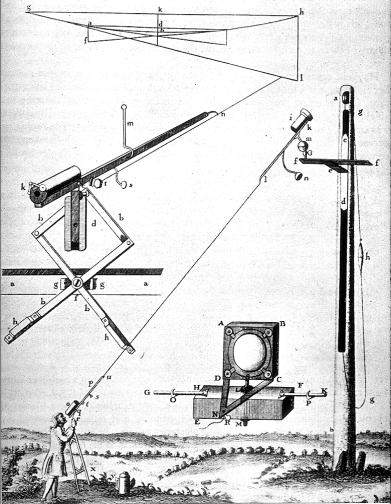
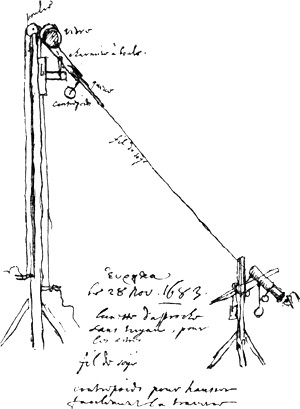 In 1681 Christiaan Huygens started to construct long focus telescopes with no tubular castings. With these large focal-ratio designs, he diminished the effect of chromatic aberration of the singlet lenses used in those days. The objective lens was mounted on a balancing device on top of a pole of 70 ft or higher. The eyepiece was connected to the objective lens by a string. The height of the objective lens was controlled by a pulley.
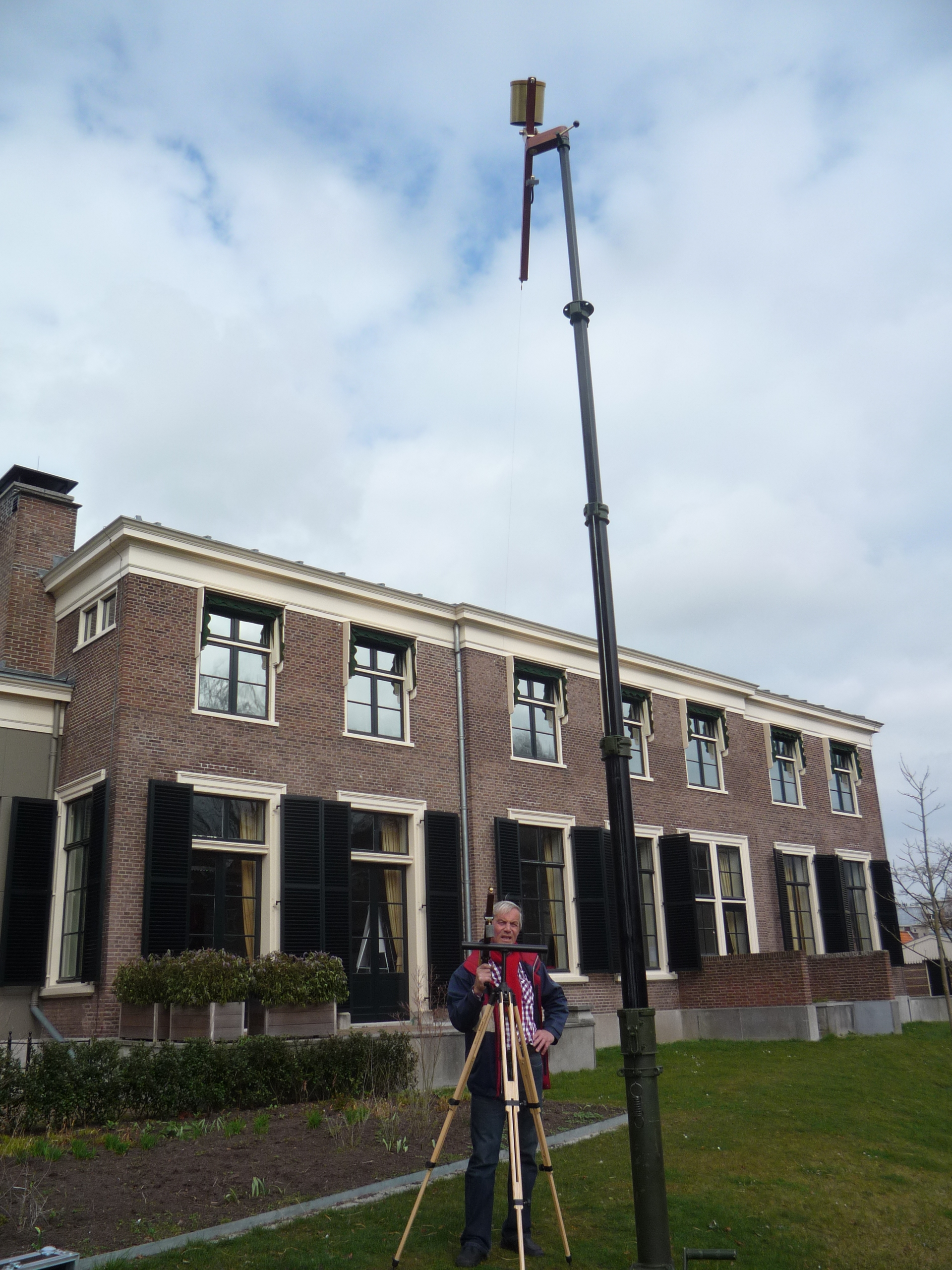
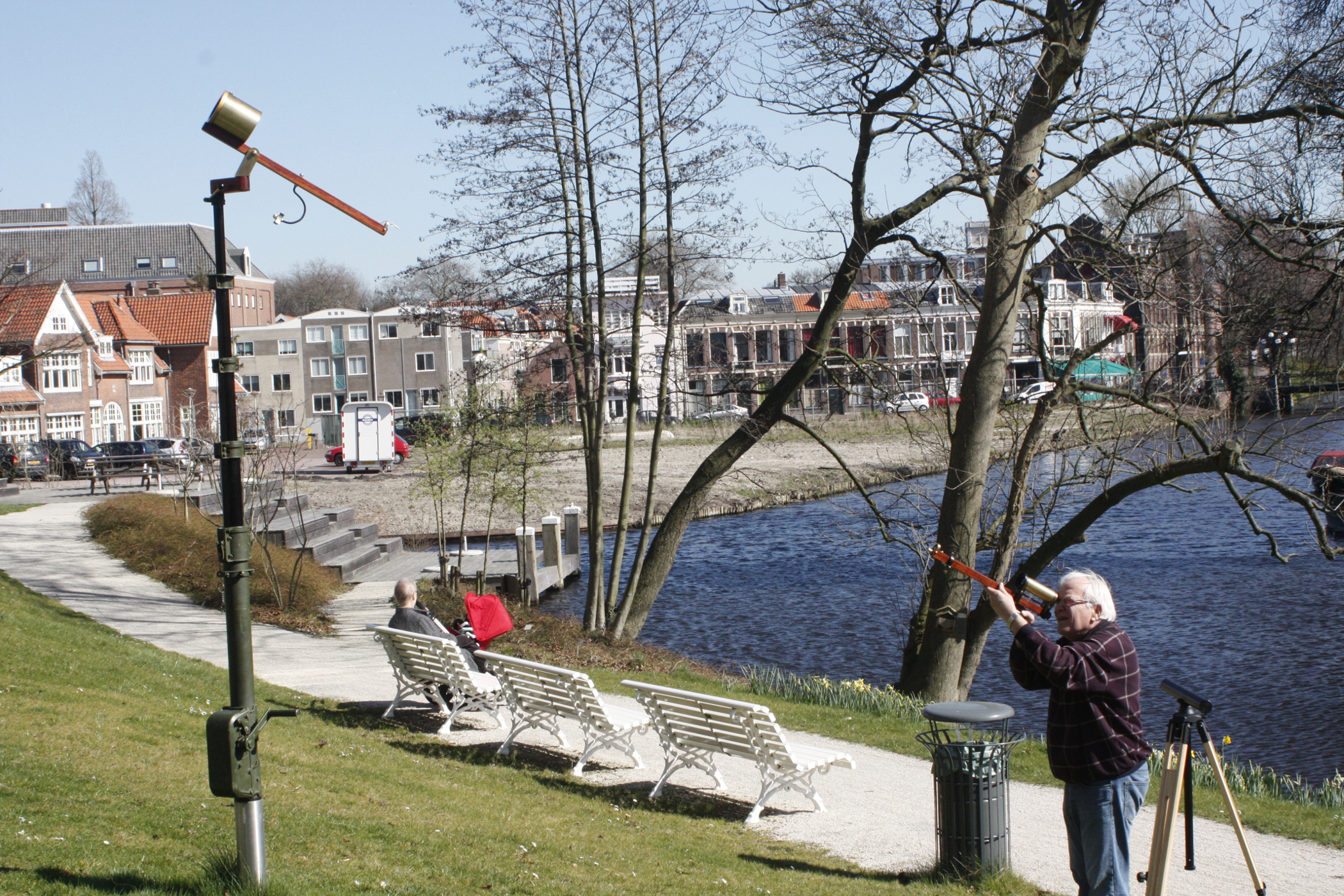
Professor Vincent Icke (Leiden Observatory) initiated the construction of an example of such an Huygens refractor. The Leiden school for fine mechanical design (LIS) carried out the construction. A permanent mounting foundation was made in the garden of the Hortus Botanicus, in front of the old observatories lecture room, adjacent to the Witte Singel. A short tube for this purpose, of about 10” high, is clearly visible in the grass.
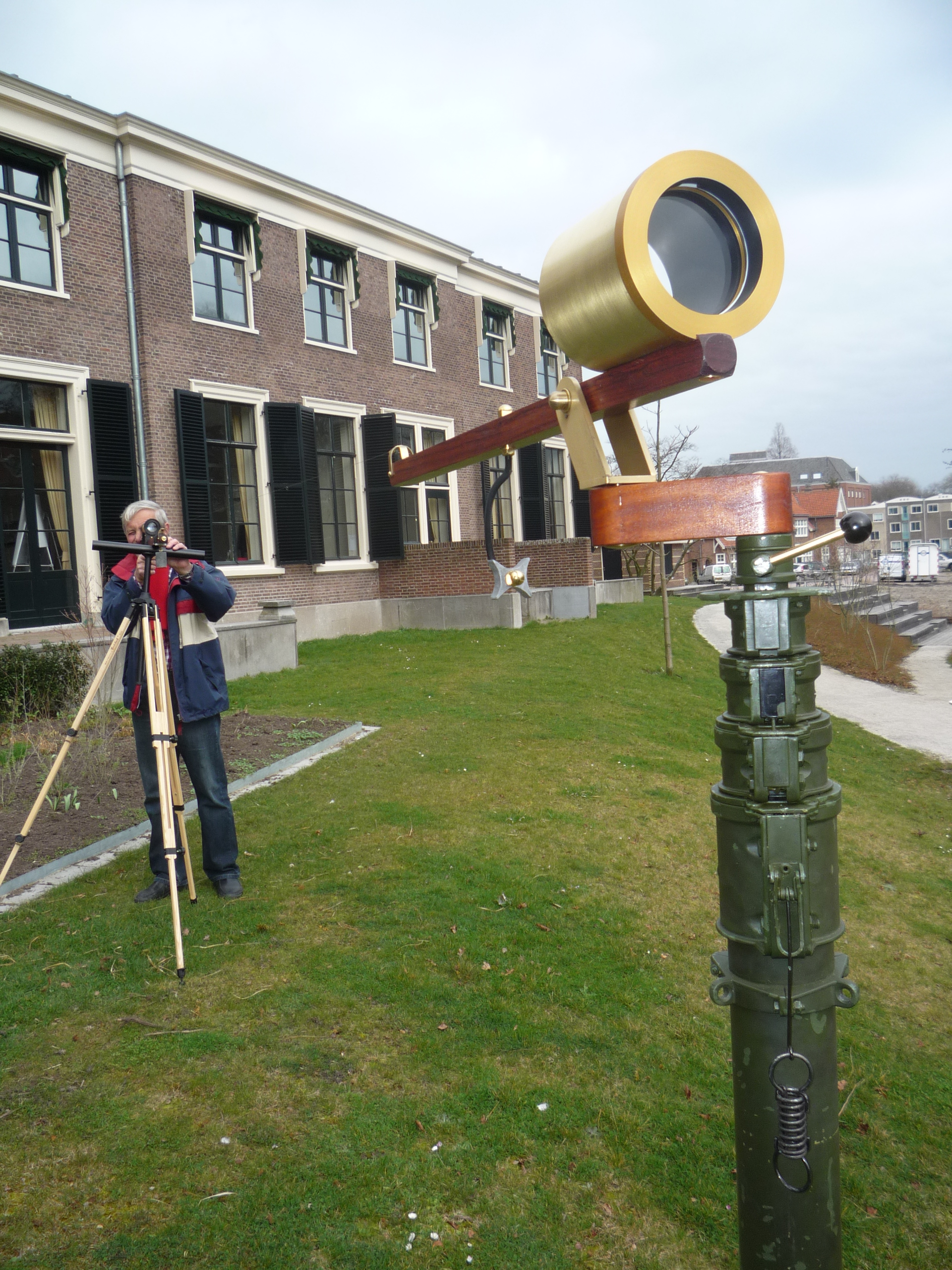
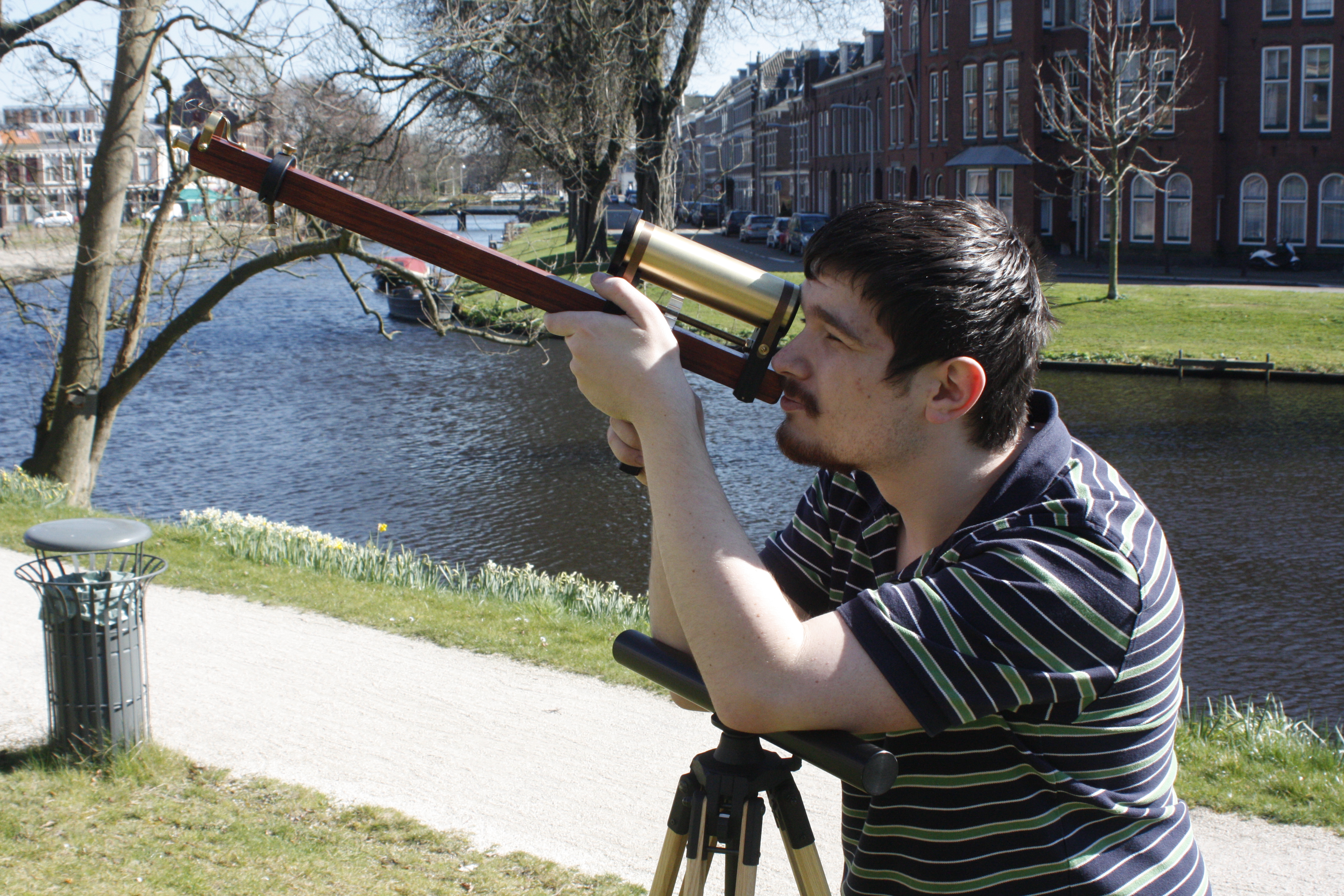
The 4” (10 cm) objective has a focal length of 4 m (the cord including hooks is 265cm). The eyepiece gives an enlargement of about 40 times. The optics are of modern design and production, such that the images are much better than what Huygens could see. Also, the main discoveries, which made Huygens famous in scientific circles, were made earlier in his life with shorter conventional refractors. His published sketches of his instrument are not to scale. The tubeless refractor is thus not a replica but a device for demonstration of principle.
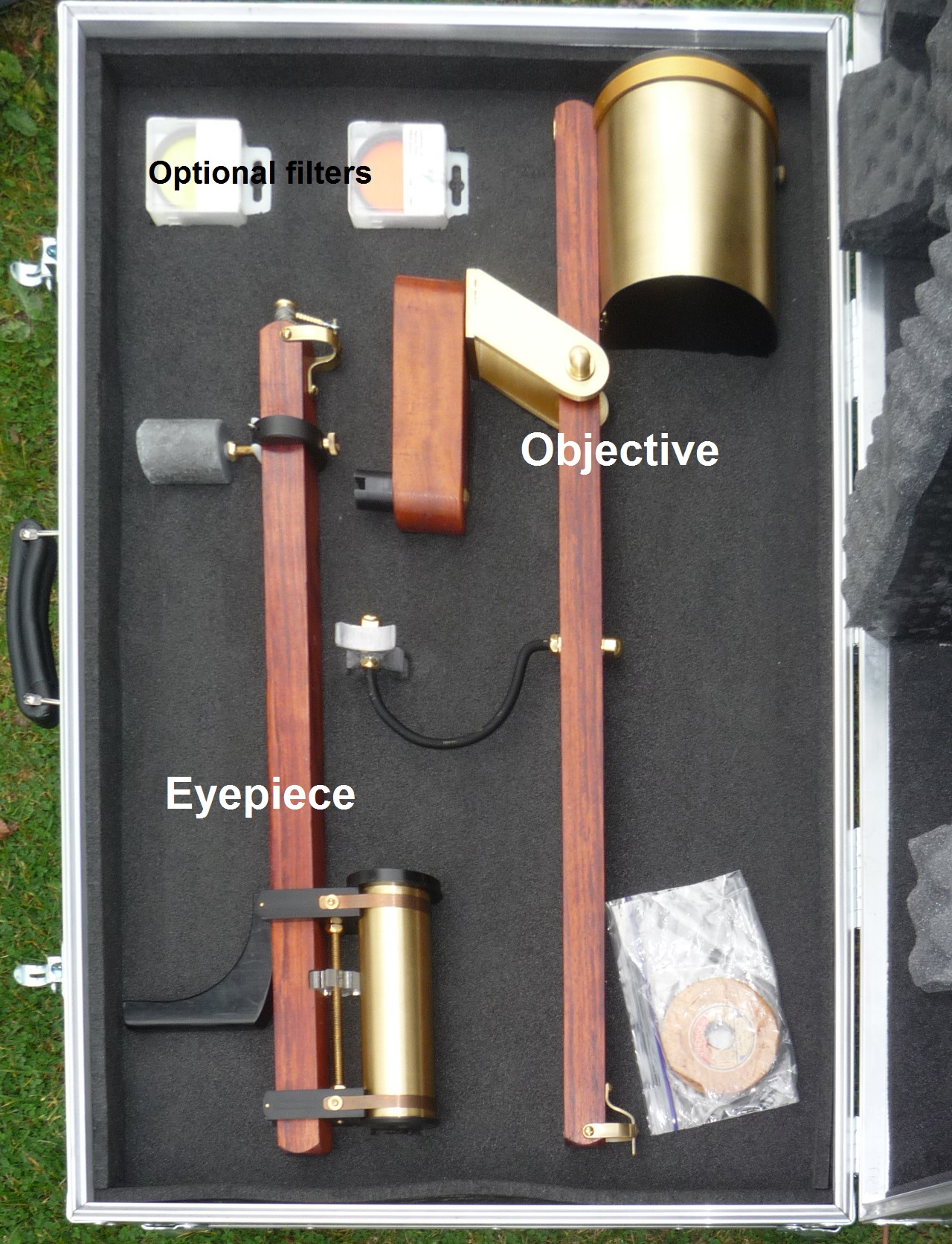
The instrument is composed of four parts:
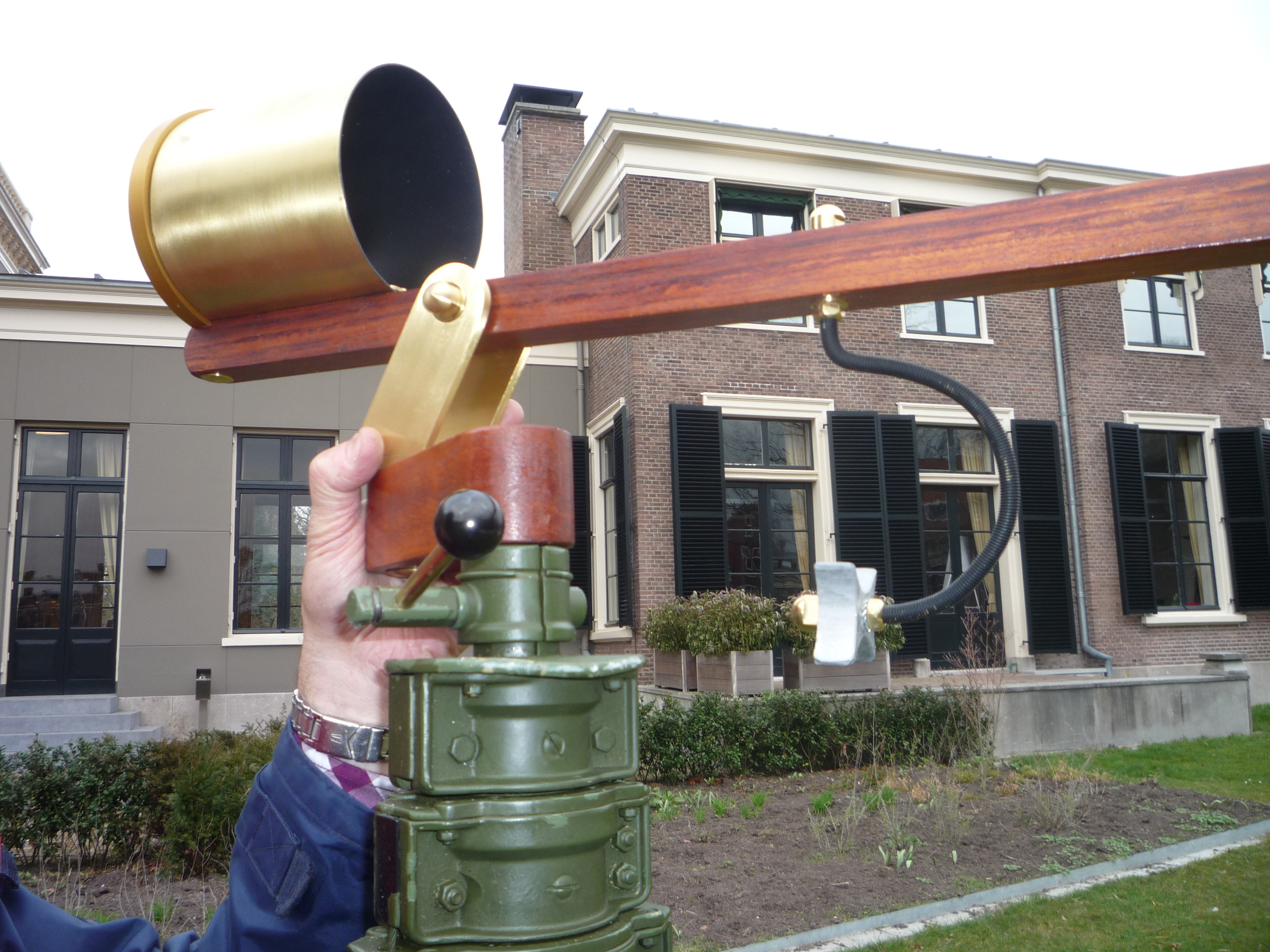
- The objective and its balancing mount.
- The eyepiece with its handle.
- The pole supporting the objective. (This was originally a portable military antennae mount.)
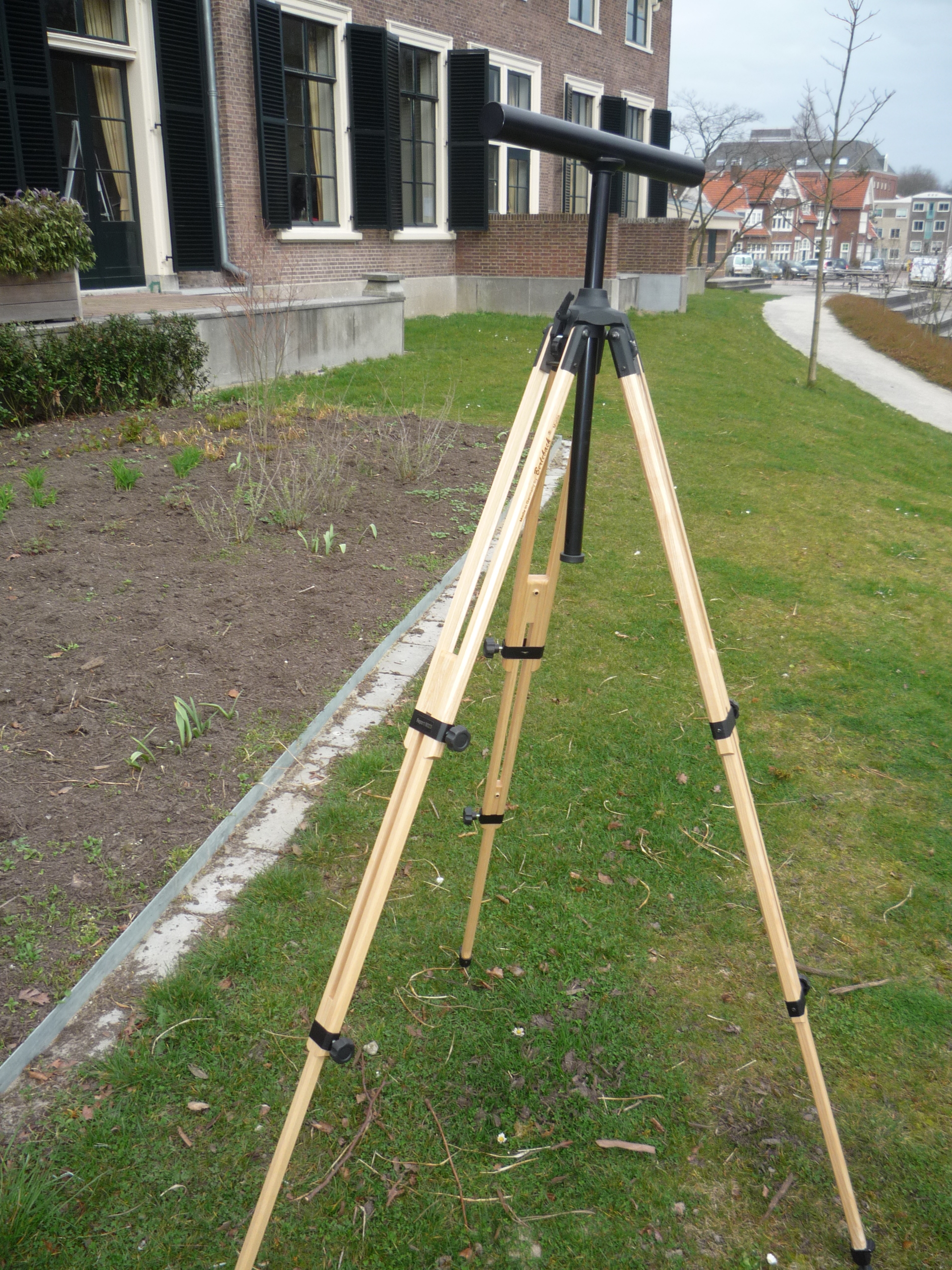
- An arm-support on a tripod for the eyepiece.
The filters are not used.
Huygens needed an oil lamp to see the outline of the objective at night, and its light reflection in the focal plane for aiming. Also he projected the image of bright objects (like the Moon and Jupiter) directly on an oiled translucent piece of paper to locate the place for the eyepiece. Presumably he used a simple singlet eyepiece; there is no proof that he ever used the dual-lens eyepiece invented by him.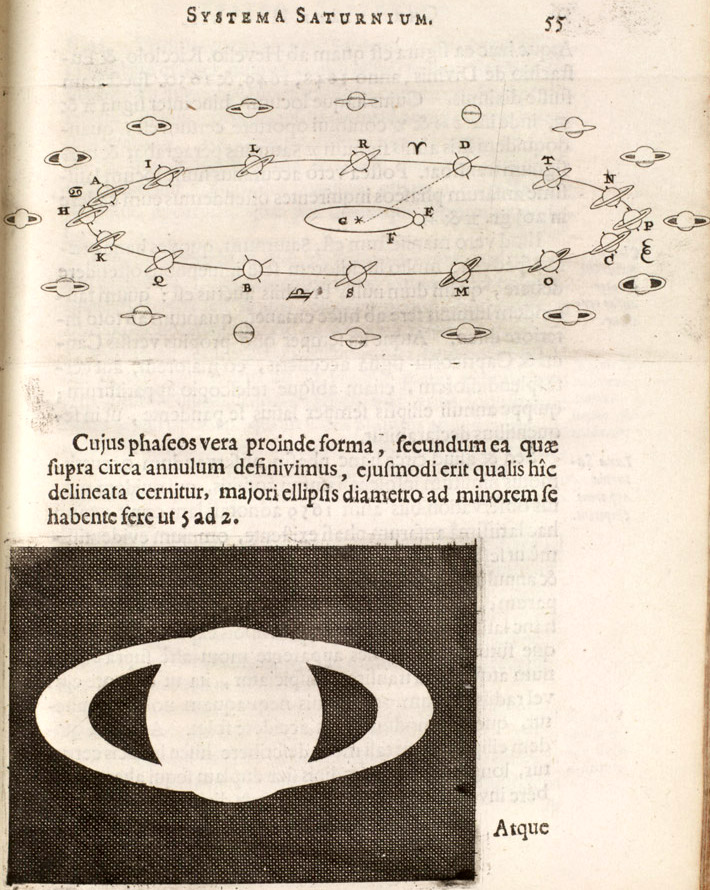
 Erecting the telescope is straightforward and can be done after having practiced it once. The objective and eyepiece are carried outside in a bag, because the storage box is heavy and not needed there. Two people are necessary for deployment. Firstly because of the weight of the different parts. Secondly to help changing the height of the pole (to adapt the elevation) when aiming at an object. When in focus, the image completely fills the field of view.
It requires quite some practice to catch an object. This can practically not done by casual passersby. Practice beforehand in daytime by looking at objects near the horizon. Don’t pull the rope too strongly: it will break (spare rope is in the box). Start at night to practice with the Moon.
Erecting the telescope is straightforward and can be done after having practiced it once. The objective and eyepiece are carried outside in a bag, because the storage box is heavy and not needed there. Two people are necessary for deployment. Firstly because of the weight of the different parts. Secondly to help changing the height of the pole (to adapt the elevation) when aiming at an object. When in focus, the image completely fills the field of view.
It requires quite some practice to catch an object. This can practically not done by casual passersby. Practice beforehand in daytime by looking at objects near the horizon. Don’t pull the rope too strongly: it will break (spare rope is in the box). Start at night to practice with the Moon.
Historical scientific background:
Christiaan Huygens was an important scientist in the timeframe between Galilei and Newton.
- Galileo Galilei (1564 - 1642)
- Christiaan Huygens (Den Haag, 1629 –1695)
- Isaac Newton (1643 –1727)
Huygens can be called one of the first theoretical physicists. He was active in the fields of mathematics (probability, differential- and integral analyses), physics (elastic collision, mathematical swing, centripetal force, lightwaves, light refraction, polarization, interference, acoustics), astronomy (Saturns ring and moon Titan, Mars), and inventions (pendulum clock). Also he wrote early science fiction (extraterrestrial life).
In astronomy he extensively developed new instrumentation and used that for observations. The telescope, invented in 1608, was new at those times.
Research was pursued by (rich) individuals, universities were meant for passing knowledge, and vocational training was done on the job (guilds) or in army schools. The Huygens family was rich, and well connected to the political elite. Christian, supported by his brother Constantijn, devoted his life to science. Together they fabricated many lenses. He was active in European scientific circles, e.g. he met Boyle and Newton.
Telescope timeline:
1655 first useful refractor 3,7 m metal tube (12 ft) (57 mm objective, stopped to 35 mm, magnification 43X). Used for the observation of Titan on 25 March.
1656 large refractor of 7,3 m (24 ft).
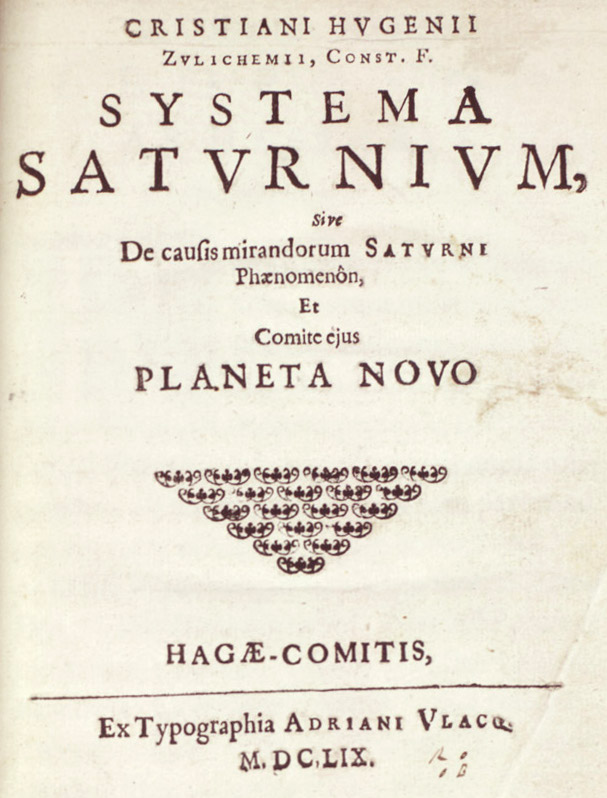
1659 publication of “Systema Saturnium” (Rings of Saturn,”Huygens” eyepiece)
1663 member of the Royal society in London.
1666-1681 director research of the Académie de Sciences Paris.
1659-1681 no refractors were built.
1683-1687 tubeless “aerial” refractors of up to 210 ft.
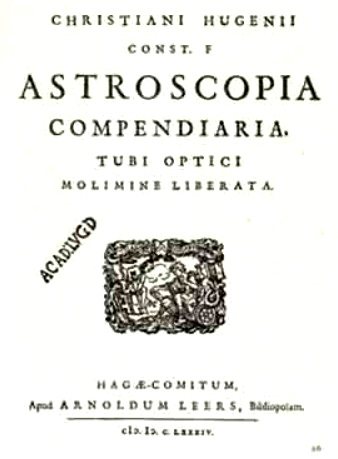
1684 publication of “Astroscopia Compendiana” (description of tubeless refractor)
Huygens Telescope
Stories
Stolen from wikipedia
Around 1675 the brothers Christiaan and Constantine Huygens decided to accommodate the very long focal length objectives they were creating by eliminating the tube altogether. In the Huygens' “aerial” telescope the objective was mounted inside a short iron tube mounted on a swiveling ball-joint on top of an adjustable mast. The eyepiece was mounted in another short tube (sometimes on a stand), and the two tubes were kept aligned by a taut connecting string. Christiaan Huygens published designs for these tubeless “aerial telescopes” in his 1684 book Astroscopia Compendiaria, and their invention has been attributed to him and his brother Constantijn, although similar designs were also used by Adrien Auzout; the idea is even sometimes attributed to Christopher Wren.
 The Huygens contrived some ingenious arrangements for aiming these “aerial telescopes” at an object visible in the night sky. The telescope could be aimed at bright objects such as planets by looking for their image cast on a white pasteboard ring or oiled translucent paper screen and then centering them in the eyepiece. Fainter objects could be found by looking for the reflection of a lamp held in the observer's hand being bounced back by the objective and then centering that reflection on the object. Other contrivances for the same purpose are described by Philippe de la Hire and by Nicolaas Hartsoeker. The objectives for aerial telescopes sometimes had very long focal lengths. Christiaan Huygens states that in 1686 he and his brother made objectives of 8 inch (200 mm) and 8.5 inch (220 mm) diameter and 170 and 210 ft (52 and 64 m) focal length, respectively. Constantijn Huygens, Jr. presented a 7.5 inch (190 mm) diameter 123 ft (37.5 m) focal length objective to the Royal Society of London in 1690. Adrien Auzout and others made telescopes of from 300 to 600 ft (90 to 180 m) focal length, and Auzout proposed a huge aerial telescope 1,000 ft in length that he would use “to observe animals on the Moon”.
The extreme difficulty of using these very long focal length telescopes led astronomers to develop alternative designs. One was the reflecting telescope. In 1721 John Hadley showed a Newtonian reflecting telescope to the British Royal Society with 6 inch in diameter mirror. The instrument was examined by Society members James Pound and James Bradley who compared its performance to the 7.5 inch (190 mm) diameter aerial telescope built by Constantijn Huygens, Jr. that the Society had in their collection. In the comparison they noted that the Hadley reflector “will bear such a charge as to make it magnify the object as many times as the latter with its due charge”, and that it represented objects as distinct, though not altogether so clear and bright as the Huygens aerial telescope.
The need for very long focal length refracting telescope objectives was finally eliminated with the invention of the achromatic lens in the middle of the 18th century.
http://homepage2.nifty.com/~cmo/97Note13.htm
Applications[edit]
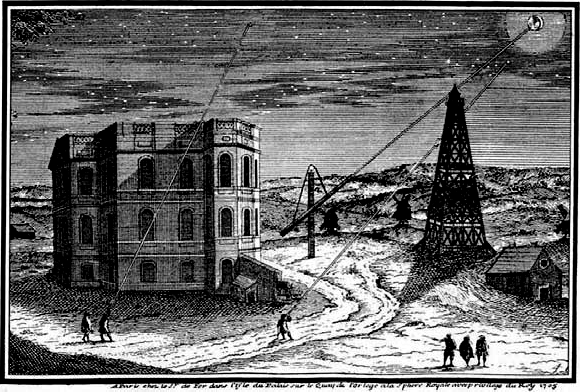
An engraving of The Paris Observatory in the beginning of the 18th century with the wooden “Marly Tower” on the right. Astronomer Giovanni Domenico Cassini had the wooden Marly Tower, originally built as part of the Machine de Marly to lift water for the reservoirs and fountains at the Gardens of Versailles, moved to the grounds of the Paris Observatory. On this tower he mounted long tubed telescopes and the objectives of aerial telescopes made for him by the Italian optician Giuseppe Campani.[6] In 1684 he used one of his aerial telescopes to find Dione and Tethys, two satellites of Saturn.[11] James Bradley, on December 27, 1722, measured the diameter of Venus with an aerial telescope whose objective had a focal length of 212 ft (65 m).[12] Francesco Bianchini tried to map the surface of that same planet and deduce its rotational period in Rome in 1726 using a 2.6“ (66 mm) 100 foot focal length aerial telescope.[13] https://en.wikipedia.org/wiki/Aerial_telescope#Tubeless_.22aerial.22_telescopes
Obsolescence[edit] The extreme difficulty of using these very long focal length telescopes led astronomers to develop alternative designs. One was the reflecting telescope. In 1721 John Hadley showed a Newtonian reflecting telescope to the British Royal Society[14][15] with 6 inch in diameter mirror. The instrument was examined by Society members James Pound and James Bradley[16] who compared its performance to the 7.5 inch (190 mm) diameter aerial telescope built by Constantijn Huygens, Jr. that the Society had in their collection. In the comparison they noted that the Hadley reflector “will bear such a charge as to make it magnify the object as many times as the latter with its due charge”, and that it represented objects as distinct, though not altogether so clear and bright as the Huygens aerial telescope.
The need for very long focal length refracting telescope objectives was finally eliminated with the invention of the achromatic lens in the middle of the 18th century. https://en.wikipedia.org/wiki/Aerial_telescope#Tubeless_.22aerial.22_telescopes