Programming
- Python (e.g. Numpy, SciPy & Astropy)
- LaTeX
- Bash
- slurm & hpc

MSc Astronomy and Data Science at Leiden University
Since 2019, I have been studying Astronomy at Leiden University. I finished my Bachelor's in 2024, and I am on track to finishing my Master's, which specializes in Data Science, in summer 2026. The aspects of my studies that I particularly enjoy working with are programming, data analysis and statistical modeling. The astronomical fields that interest me the most are galaxy formation, radio astronomy and large-scale structure.
My current focus is on my second-year Master's research project supervised by Dr. Marcel van Daalen, which investigates the velocity distribution within galaxy clusters using the kinematical Sunyaev-Zel'dovich effect in the FLAMINGO simulations. At the same time, I am writing a paper on the results of my first-year Master's research project, in which I serve as the first author. This research explores the enhancement of star formation in galaxy mergers in the COLIBRE simulations.
Outside of academia, I enjoy playing games, including bridge and Dungeons and Dragons, which I play weekly. I also like bouldering, especially at bouldering gym Krachtstof in Leiden. I spend the rest of my time with my friends and my girlfriend.
My full cv is available here
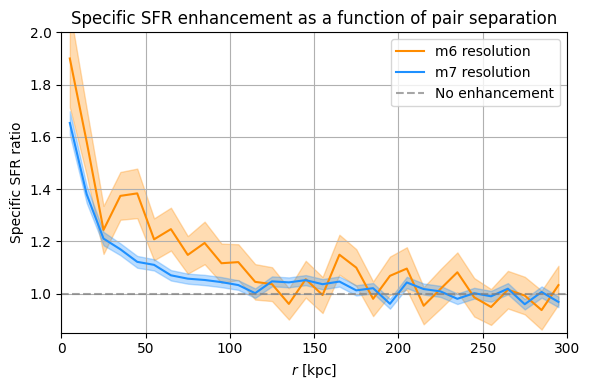
Galaxy interactions and mergers play an important role in the formation and evolution of galaxies. Cosmological hydrodynamical simulations provide a powerful tool to investigate these effects. For this reason, I conducted my first-year Master's research project on the effect of galaxy mergers on star formation in the COLIBRE simulations under supervision of Prof. Dr. Joop Schaye and Dr. Evgenii Chaikin. This is achieved by comparing galaxies with a nearby companion to galaxies from a similar environment without a close companion. Currently, I am writing a paper about the results from this research project. As can be seen in the figure, we find that star formation is strongly enhanced at low separation (< 20 kpc), and that star formation enhancement is visible up to approximately 150 kpc, for both m6 (particle mass ~ \(10^{6}~\mathrm{M}_\odot\)) and m7 (particle mass ~ \(10^{7}~\mathrm{M}_\odot\)) resolution.
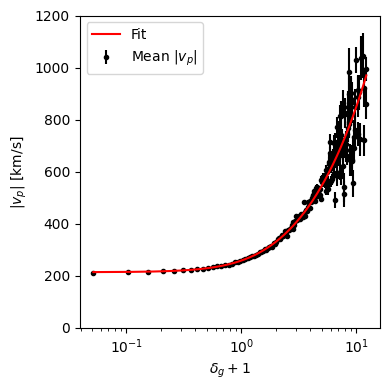
The kinetical Sunyaev Zel'dovich (kSZ) effect provides a powerful tool in calculating the baryonic mass of galaxy clusters. The kSZ effect measures the electron density times line-of-sight (LOS) bulk motion relative to the Hubble flow of a halo or cluster and is measured as a distortion in the cosmic microwave background spectrum. If the LOS velocity of a halo is known, kSZ measurements can be used to infer its mass. However, determining the velocity of a halo is hard due to the expansion of the universe. Modern research reconstructs velocities by relating the velocity distribution of galaxies to galaxy overdensity in cosmological dark matter only (DMO) simulations. My research focuses on the question whether this is a good assumption, by comparing the velocity distribution of galaxies within DMO and hydrodynamical FLAMINGO simulations. The relation between galaxy overdensity and the mean absolute value of the peculiar velocity of galaxies \((M_{subhalo} > 10^{11}~\mathrm{M}_\odot)\) within the fiducial DMO FLAMINGO simulation is shown in the figure.
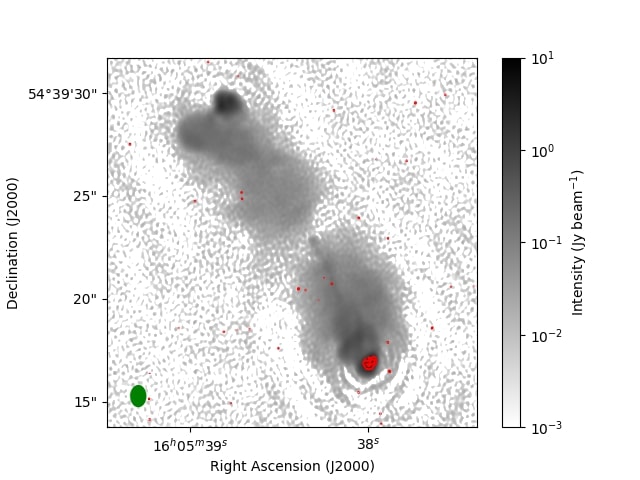
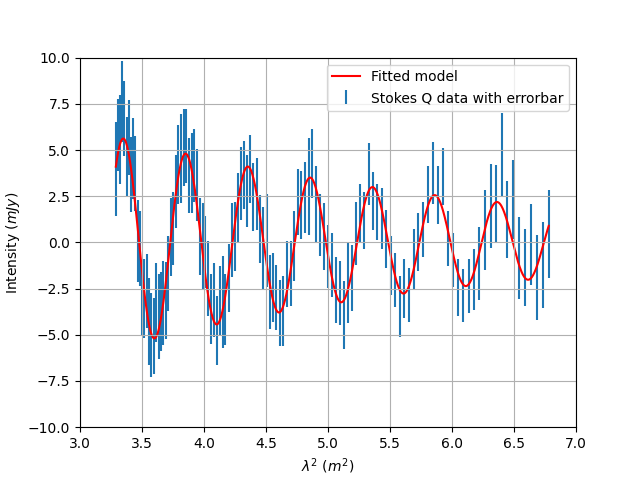
In the first half of 2024, my fellow student Daan de Jong and I carried out our Bachelor's research project on detecting galaxies that emit linearly polarized radiation in the ELAIS-N1 field with LOFAR, supervised by Dr. Reinout van Weeren and Dr. Jurjen de Jong. We managed to detect two linearly polarized sources, one of which had never been documented in the literature before as polarized. We also determined the rotation measure by analyzing the Faraday rotation, as shown in second figure, which provides information about the line-of-sight magnetic field between each galaxy and the Earth.