Table of Contents
Heliostat
The Heliostat is the first crowdfunded telescope in the Old Observatory, meant to project a 80cm solar images onto the walls of the visitors center. It was an initiative started by Leiden Observatory in cooperation with Leiden University as a test for crowdfunding in Leiden. The University was looking for suitable projects after the previous successful funding of the Zweetkamertje and this was perfect. The project was supposed to run for 3 months, but instead was funded in just a little over one. Starting on the 17th of January it was fully funded on the 19th of February! Under the motto “Breng de zon naar Leiden” (Bring the Sun to Leiden), it appeared in various newspapers, radio shows, etc. We asked the public for 19.800 euro, but ended up with 20.016 due to the site not being closed fast enough.
The original Heliostat proposal was made in 2009 by Johan from the WLS.1) Because of this idea the architect built a big tube into the roof of the building, going down all the way to the basement.


In 2014 this project was picked up by the new exhibition committee composed of Ivo, Sascha and Alex. Mainly because of the 84% solar eclipse which would take place on the 20th of March 2015. This was enough reason for the observatory and university to turn this into an enormous crowdfunding project composed out of a team of [?] people. This team was composed of observatory staff, instrument makers from the LIS, students, amateurs from the WLS and PR persons from the university. For a full list look in the contributors section.
Telescope
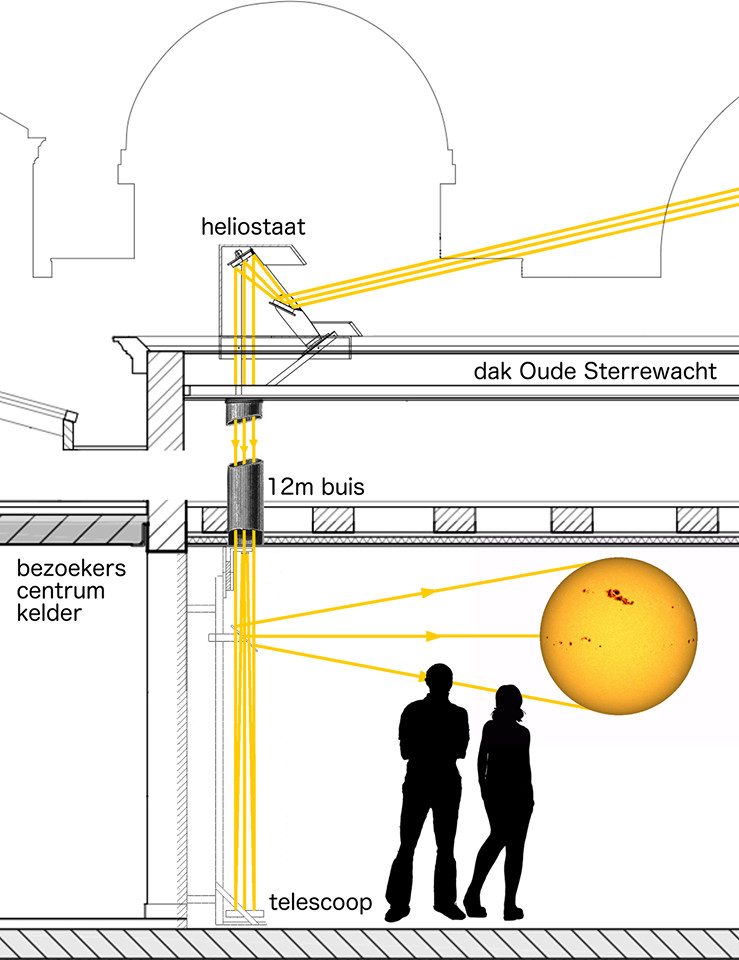
The heliostat is composed out of two parts, one on the roof and one in the visitors center. The top part is a simple heliostat, composed out of a Celestron mount with a flat mirror in its heart. This alt-az mount will be able to track the sun from about 10:00 AM to 6:00PM, depending on the time of the year. It will then reflect the solar image into the tube down to the Kutter telescope which scales and projects the image onto the wall.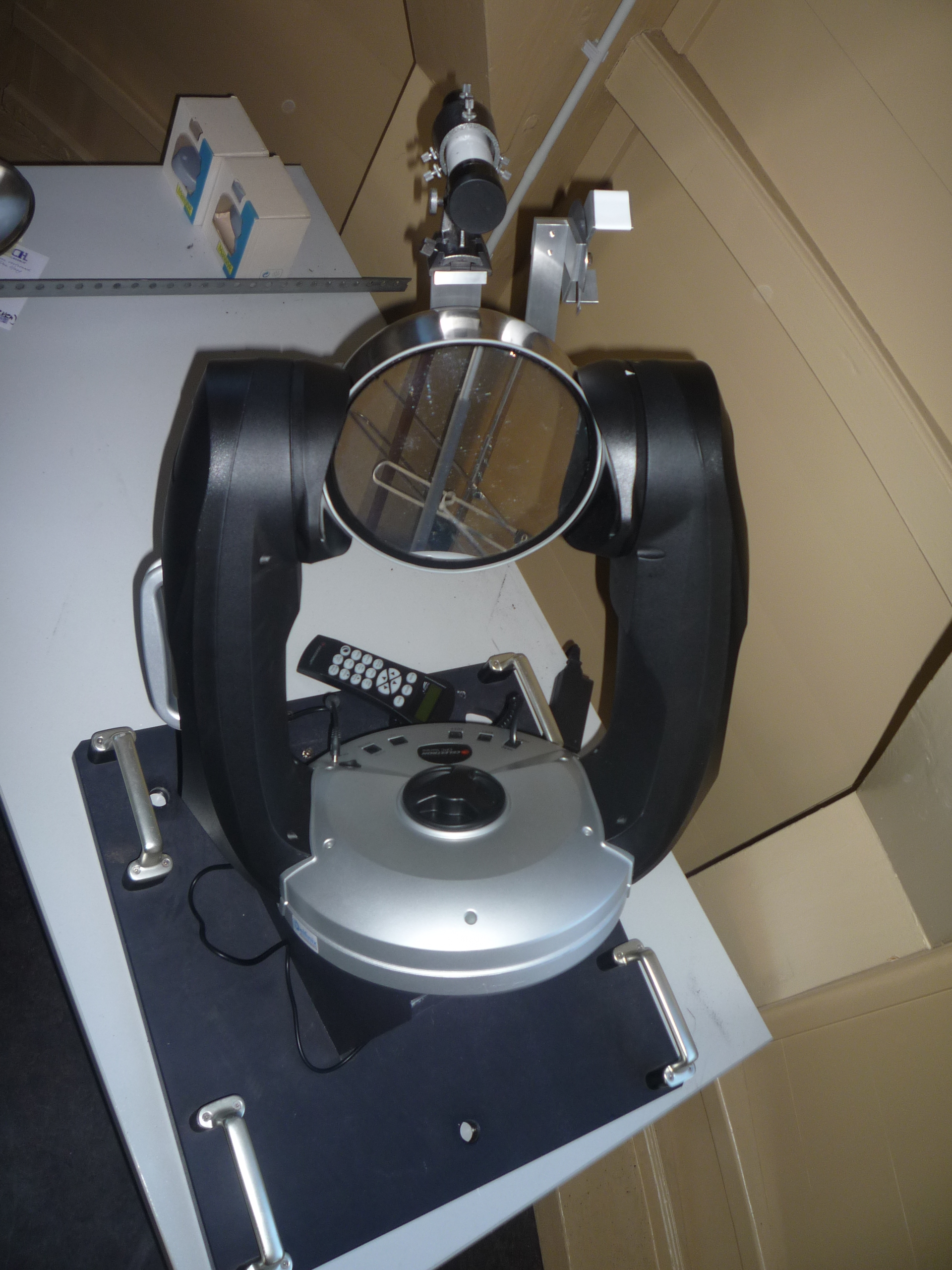
 A Kutter telescope or a Schiefspiegler, is a variant of the Cassegrain and uses tilted mirrors to avoid the secondary mirror casting a shadow on the primary. However, while eliminating diffraction patterns this leads to an increase in coma and astigmatism. These defects become manageable at large focal ratios like f/15 or longer. This tends to restrict useful observation to the moon, planets…and the Sun. The Kutter style uses a single concave primary, a convex secondary and a plano-convex lens between the secondary mirror and the focal plane. (Click image to enlarge)
The dome will be a zinc structure (like the other domes), currently dubbed “the baby carriage”. It will be operated manually from the visitors center and later might get a rain sensor and become automatic.
Instructions
To use the heliostat, two passwords are required. One for the computer in the visitors center. One for the computer that controls the heliostat in the attic.
Password for computer in visitors center: dezon=ok4us
Password for computer in the attic: zon=pr8ig
To restart the heliostat pc, just do: start→run cmd (and in the command window type: 'shutdown -r') Without the quotes and with the -r (otherwise the pc will just shut down and will need to be turned on physically)
Contributors
I'm not sure if this is a complete list, please check!
Heliostat Committee
Ivo Labbe, Alex Pietrow, Johan van Kuilenburg, Kees Moddemeijer, Jaap de Bree, Donald van Burg, Remko Stuik, Frans Snik, Dick Harms, Cloeck Beekhuis, Gerard Smit, Sascha Zeegers
Crowdfunding Group
Ivo Labbe, Poppy Savenije, Pim Overgaauw, Josha van Houdt, Silvia Toonen, Benne Holwerda, Arjan van der Hulst, Wouter Kuip, Roel Brouwers, Alex Pietrow, Piet Basitaanse, Brecht Simon, Lieke van Son.
Anecdotes
- The flat mirror that projects the Sun on the wall used to be installed upside-down. (So the reflecting side on the bottom and not at the top) This caused the image to be quite fuzzy (Due to internal reflection) with a resolution far below what was expected. This caused some panic with the group until it was discoverd what the problem was. After it was flipped the telescope worked well.
[ ]
]
- When the dome was installed, it was discovered that some last minute changes were made to the design. An extra axle was added to the dome so that the torque could go via that and not the outside of the dome. This axle fit perfectly if you looked at the blueprint of the telescope, however only if the telescope does not move. Being left with enough space to work for about 30 minutes a day, the heliostat was not in its most useful state. Fortunately the LIS added a bend to the axle and fixed the problem. (see photos)
- When the dome did not yet have a working motor to open and close it and had to be opened/closed by hand, the LIS wanted to make it ready for action as soon as the motor would arrive. One of the things that they have done was balance it perfectly. They stated proudly that the dome was so well balanced that you could no open it with a single finger. When we asked if the wind could also do it, they admitted that that could be a problem, and a wedge was placed to keep the dome closed until the motor arived.
- The heliostat is not always clear to people, once Alex got asked to turn on and demonstrate the telescope. However it was already on, the visitors thought that it was a dirty spotlight on the screen.
- The dome is quite nasty when operated manually, you have to watch out not to catch your fingers between the metal when opening it, as two sharp parts meet. Exactly this happened when the electrician was mounting the dome motor, and his fingers were quite badly scalped. Spots of blood can still be found on the wood inside the dome to remind us of the dangers.