10-inch refractor
History
- Purchased in 1885 by H.G. van de Sande Bakhuyzen
- Manufactured by Repsold un Söhne in Hamburg
- The lens was manufactured by Alvan Clark & sons in Cambridgeport, Massachusetts, USA
- It replaced the 7-inch refractor that used to be in the Northern dome
- It was used to observe the relative positions of binairies
Observing
Short facts about the telescopes
| Main telescope | Guidescope | Finderscope | |
|---|---|---|---|
| Lensdiameter | 266 mm (10 paris inch)1) | 100 mm | 50 mm |
| Focal length | 3992 mm | 233 mm | |
| Field of view | +- 28' | +- 3° | |
| Magnification | 125-333 | 7 | |
| Resolution | 0.43“ | ||
| Limiting magnitude | 13.9 | ||
| Focal ratio | 15 |
Guide scope
- Focal length: 233 mm? (number is on the side of the lens)
- Lens diameter: 100mm
- Field of view: +- 28'
- Carl Zeiss lens
Finderscope
- Lens diameter: 50mm
- Field of view: +- 3°
- Magnification: 7x
Oude dingen
[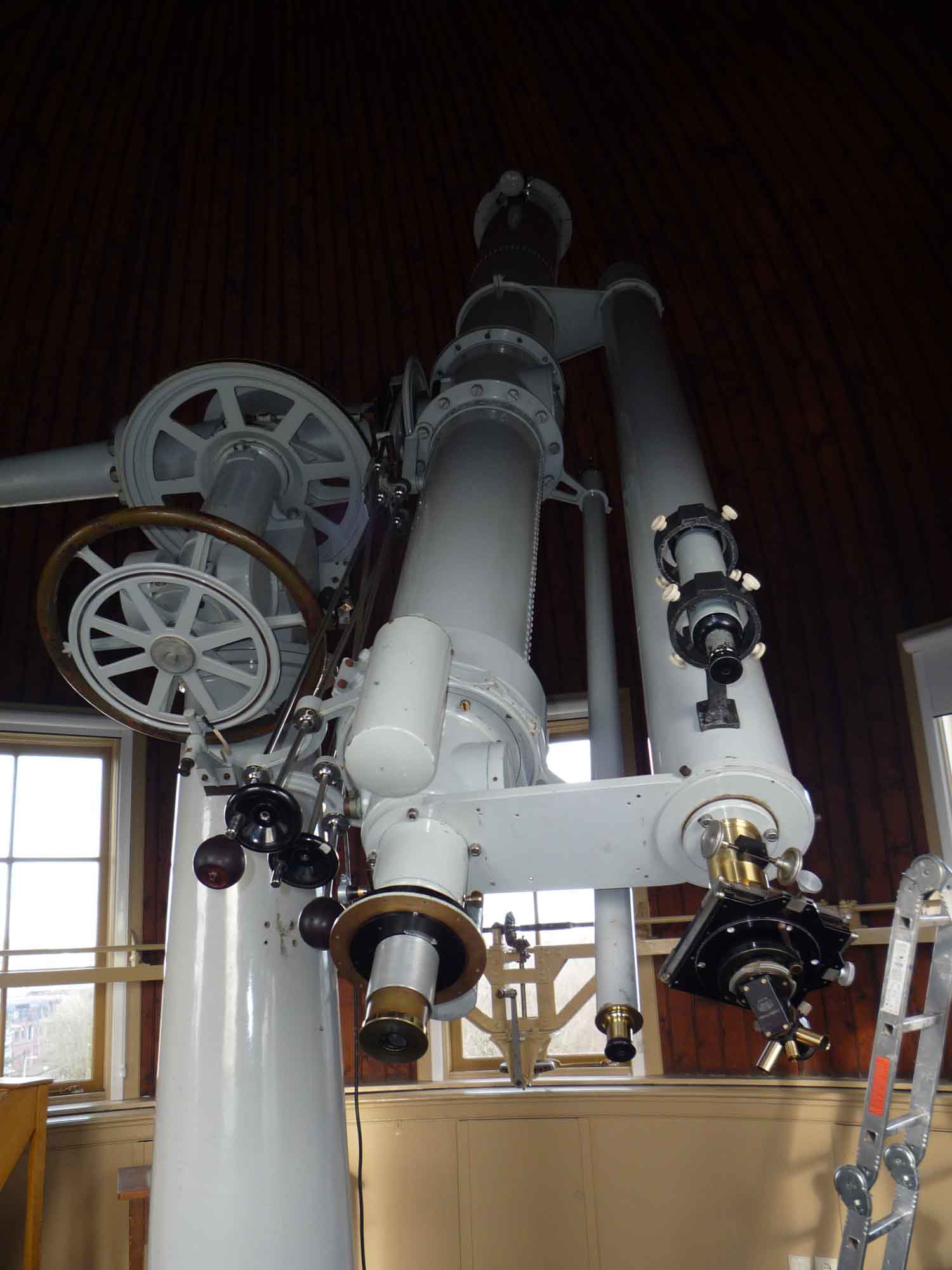 ] In the big, northern dome on the roof of the Observatory, we find the 10 inch refractor. This telescope was build in 1885 by Repsold und Söhne, but the lens was manufactured by Alvan Clark & sons, an American company.
[
] In the big, northern dome on the roof of the Observatory, we find the 10 inch refractor. This telescope was build in 1885 by Repsold und Söhne, but the lens was manufactured by Alvan Clark & sons, an American company.
[ ]
]
New:
- At the sidewall of the stairs is a switch located to the left, which activates the power of the mount (the metal box at the base). When this switch is turned off you are certain that the telescope drive, small lamps, and objective heater are off, so now harm can be done by a running motor you forgot. The activation of the switch is shown by a led. ALWAYS TURN OF THIS SWITCH WHEN LEAVING THE TELESCOPE. Incase of doubt if you, or somebody else, turned it off, you MUST go back to check it.
The electricity on the walls are not affected by this switch in order to keep lights and computers on at will
- The switch that turns the streetlights at the Sterrenwachtlaan on- and off is operating. It works as a toggle. When going home turn the lights on again. The guards and personnel who start early in the morning asked for this.
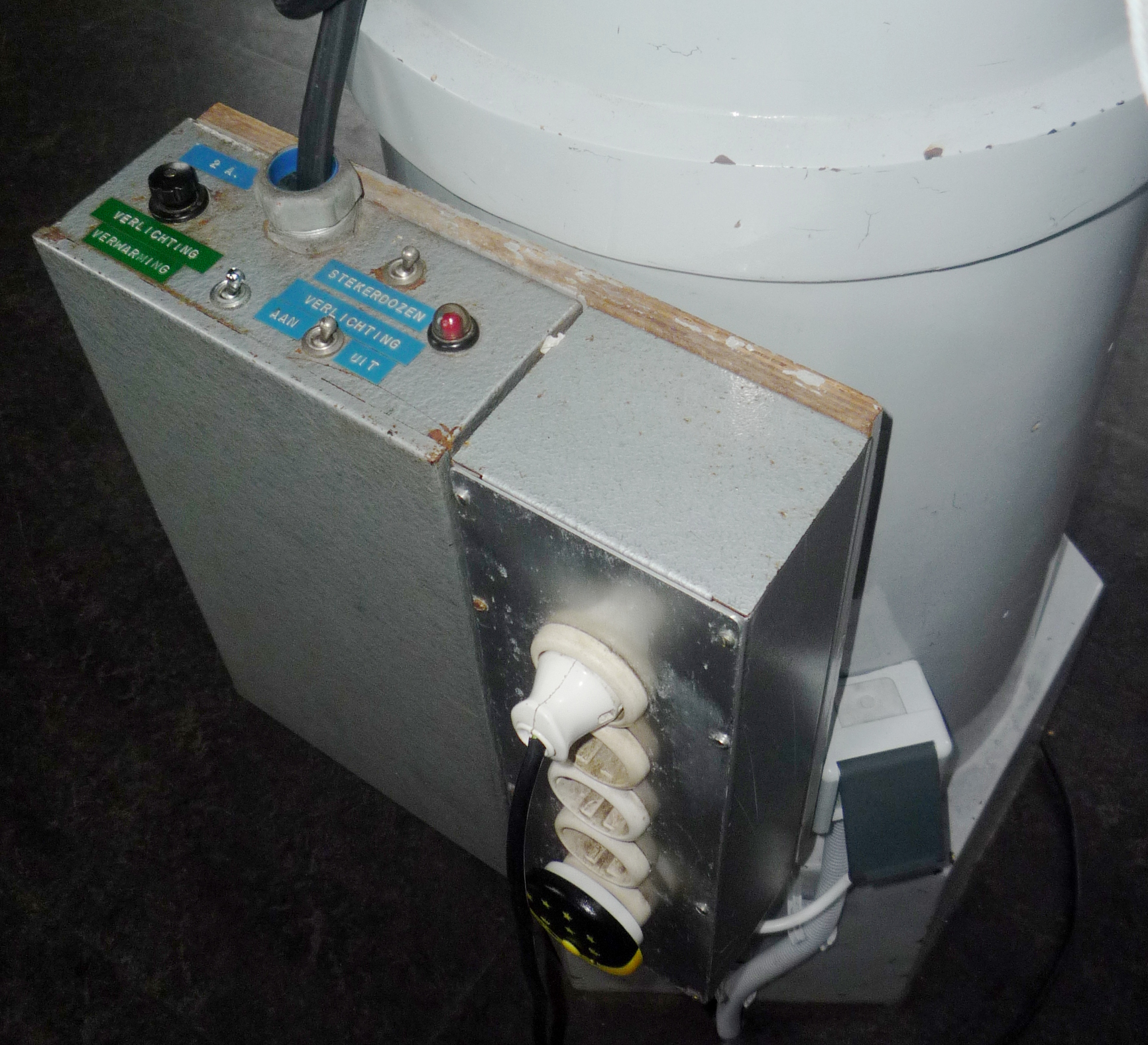
- The metal box at the base of the mount was put back. Power to the telescope mount thus passes the main switch at the stairs, the wall socket below the metal box, the socket row om the metal box, and the switches on top of the metal box itself.
- In the corridor, to the right of the entrance door to the 10” dome, is a toggle-switch which controls the lights in the corridor and down the stairs to the ground floor.
Main telescope
History of telescope
 The 10 duims or 10-incher was made by the firm Repsold und Söhne from Hamburg in 1884. The lens, however, was ground by the famous lens grinder Alvan Clark & Sons from America (who also made the lens of the 1m Yerkes telescope). The telescope was purchased by H.G. van de Sande Bakhuzyen (Kaiser's successor) in 1885. This was quite an exceptional decision, because in that time the German industry dominated the European market.
The 10-inch telescope replaced the 7-inch (18 cm) telescope in the north dome. and was mainly used for observing the relative positions of binaries. The 7-inch was much smaller than Kaiser wanted, but after the building was finished, there was no money left to order a bigger instrument. The 7-inch was already scheduled to be replaced in 1882. After installment of the 10-inch it was stored, and in 1920 given to the Bosscha obseravtory in Indonesia (then a colony). The 10-inch is, together with the 10-inch telescope in Sonnenborgh in Utrecht, the largest refracting telescope for visual use in the Netherlands. 2) There were throughout the years alterations were made to the telescope. The main scope is still original, the guide scope and electricity were added later. The motor drive is also recent: on delivery the hour angle drive was weight driven. Unfortunately this mechanism is lost, but we know it from similar telescopes.
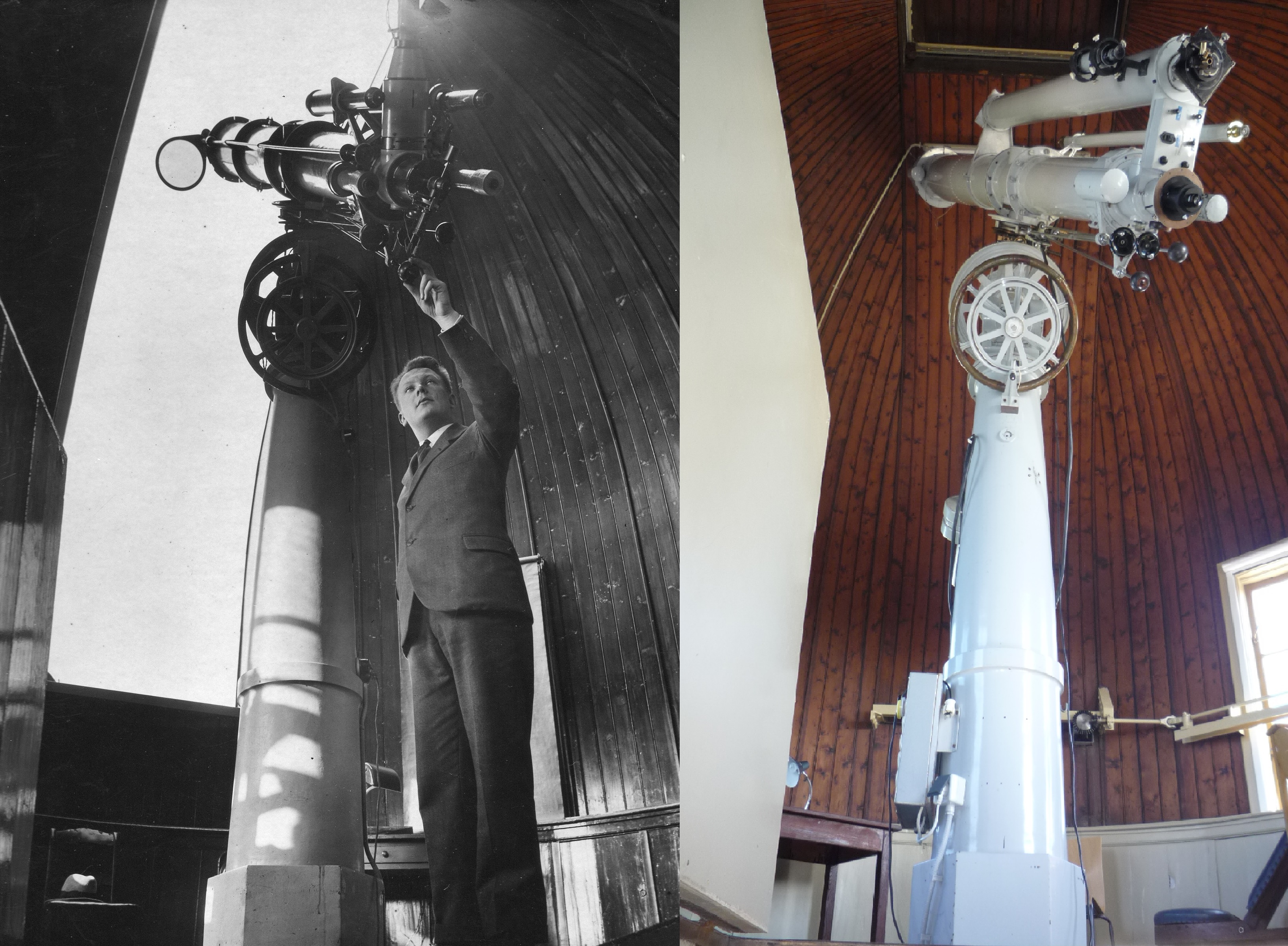
Alongside the main telescope is the finder scope and a small, recently added finder (aiming scope). The stability of the telescope is guaranteed by its 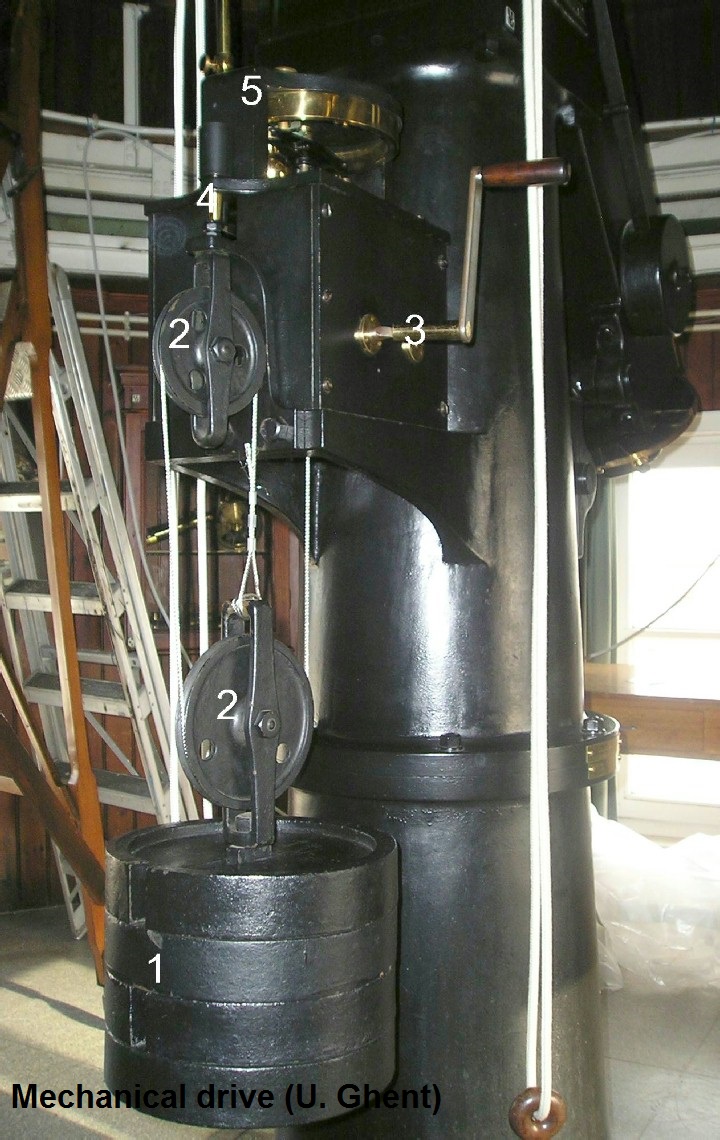 independent support pillar, separate from the main building, and braced by 81 support beams in the ground. The central pillar in the lobby of the entrance to the Observatory is the base of the telescope.
The telescope has an equatorial mounting. That is to say that the telescope can be rotated around an axis which is parallel to that of the Earth’s, and an axis perpendicular to the Earth's rotation axis. This is handy when an observer wants to track an object while observing, because then it is only necessary to rotate the telescope along one axis. Although due to current technology this no longer remains a problem and often astronomers opt for a simpler azimuthal mounting. This way the telescope can rotate both horizontally and vertically.
[ ]
]
North dome
The dome was last remodeled in 1889.
Stories and Anecdotes
This telescope was used by the astronomer Gerard Kuiper. He did his PhD research (promotieonderzoek) with the 10-inch which he finished in 1933. The title is “Statistische Onderzoekingen van Dubbelsterren”. When he was putting up wires for the wire cross Ehrenfest came into the dome and pointed at the black hole and asked “What does this do?”. Kuiper answered that the black hole used to hold his wire cross. (that is, until Ehrenfest destroyed them).
Myths
The small blue chair in the dome belongs to the original furniture of the telescopes in the Old Observatory. This chair was at one time used by the visiting scientist, Einstein. However it is not well known whether or not he participated in observations at the telescope.
Telescope instructions

THE EYEPIECE END OF THE TELESCOPE
- A main telescope
- B secondary telescope (fixed eyepiece and zenith prism)
- C finderscope
- D periscope
- E butterfly nut assurance focusing
- F focusing knob
- G eyepiece socket. The Erffle ocular is placed on the telescope by default; you are requested to put this back up at the end of your observing session (and use it to focus on a star or the like!). The clamping (round knob) and fine tuning (disk-like knob) in right ascension are the two knobs in the direction of the declination-axis (the counter weight) 'horizontally'. In declination, these are the knobs 'vertically'.
- H1 Fixation of right ascension, round knob with (with point at the end)
- H2 Fine tuning of right ascension, disk-like knob. The fine tuning has a limited range!
- I1 Fixation of declination, spherical knob.
- I2 Fine tuning declination, disk-like knob. Fine tuning has a limited range!
- K Removable balance weights
- L Balance-weight instead of micrometer
- M1,M2 adjustment crosshairs of secondary telescope
- N switch box - disassembled

THE TELESCOPE AND THE MOUNT
On the declination-axis is the engraved declination circle. You can read this with the aid of the periscope. At the end of the periscope there is a light that illuminates the reading point on the circle. At the bottom of the hour-axis, you can find the hour angle circle, also provided with a magnifying glass and illumination. You can use this to put the telescope at a specific hour angle. You can rotate this hour angle circle.
In order to be able to use the hour angle circle in a traditional manner, one should make sure to check the exact position of this circle. By means of calibration, the ornamental globe on one of the peaks of the former anatomical lab of the RUL can be used. On the photograph you see the necessary piece of skyline. The calibration point is located on the righter most peak, provided with a weather vane. A little under it is the ornamental globe. If you place the middle of this globe in the middle of the field of view of the main telescope, one should be able to read off an hour angle of 22h18.6m. If necessary one can set the hour angle circle to this value. The tracking engine should be turned off in this case, but hopefully that goes without saying!
 A little above the hour angle circle there is a bigger, leather ring: it is reminiscent of the steering wheel of an “oldtimer”. Using this, one can move the (not-fixed) telescope, starting from the readout point, around the hour-axis.
Along the column of the telescope, at knee-height, there was a switch box with a number of sockets, two switches and an indicator light. These have temporarily been removed. Hence, the engine goes directly into the socket, without indicator light, switch or fuse.
The objective heating ensures that, even when there is a significant amount of dew, the objective will hardly be affected by water vapor. If it is connected, this heating system is always switched on.
THE EYEPIECE SOCKET: VISUAL OBSERVATION
 On the back of the telescope there is a bayonet mount. Part B/C can be left in, but when you want to use a solar projection set, B and C must be replaced by the projection set. All other aids can be screwed in plate C. If you want, several attachments can be put on the telescope. Using it visually, as well as for specific photographic and photometric usage is possible.
There's a Repsold threadmicrometer for binaries present, but you are only allowed to use this if you know how to handle it.
For all attachments that must be screwed in: 'finger-tight' is sufficient, it is undesirable to screw as far as you can.
THE EYEPIECE SOCKET: CAMERA ATTACHMENT
A DSLR camera needs a 1¼“ adapter, CDD camera's as a rule already have a 1¼” nosepiece. These parts are in the basement.
The telescope has a rather limited swing for focusing, thus the adapters have to be changed.
- The eyepiece holder for visual observations has to be unscrewed carefully.
- The baseplate has to be taken off.
- The 1¼“ adapter has to be fitted from the inside.
- The baseplate must be reinstalled.
Let yourself show this operation before you try it yourself.
The Canon-DSLR fits directly, the DMK expects a filterwheel as spacer.
THE EYEPIECE SOCKET: SMARTPHONE ATTACHMENT
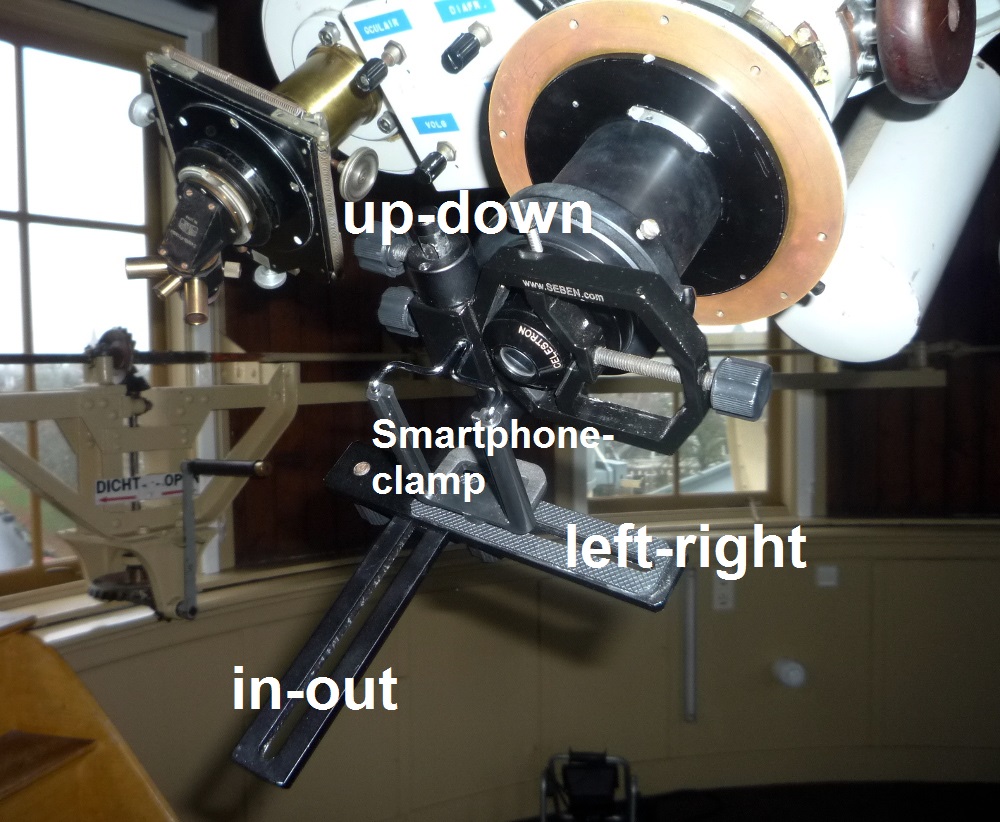 A simple adapter meant to make pictures trough the eyepiece is to be found in the basement. It is specifically meant to allow visitors to take snapshots for taking home. It is easy to do but practice it once before using it.
EYEPIECES
There are five eyepieces for visual observations.
For tours through the building and the domes (without a specific observational goal):
- Number 1 is a cheap 1¼” eyepiece that is always in the telescope as a seal and to be able to quickly look at a church (or the like) during a tour.
- Number 2 is a simple 1¼” eyepiece that can be exchanged with number 1 quickly for a little more serious demonstration.
| F | Model | Magnification | |
|---|---|---|---|
| 1 | 32 mm | Plössl | 125x |
| 2 | 25 mm | Celestron | 160x |
For tours and directed observations, the following 2“ oculars are present:
| F | Model | Magnification | |
|---|---|---|---|
| 3 | 35 mm | Televue Panoptic | 114x |
| 4 | 21 mm | Baader Hyperion | 190x |
| 5 | 12 mm | Nagler | 333x |
For the fixing of the eyepieces the 1¼” ring is present by default. This ring can be removed manually. The second adapter-ring is for the 2” eyepieces. This adapter-ring cannot be removed manually, because that's only necessary for the antique Repsold ocular, which is not present at the telescope by default and is not used in general. The eyepieces are available in a light blue suitcase in the wardrobe at the reception of the visitors center. If there is a closet in the 10“ dome in the future, this will be used to store the eyepieces.
ELECTRICAL EQUIPMENT IN THE 10"
- Smoke detector
- Lane lighting (pressure switch)
- Three double sockets at hip height. Double switch next to the hatch to with the upper and lower sockets on and off, respectively.
- Two double sockets at the floor (switched on permanently)
- One double socket on the mount of the telescope
- One socket for the heating
- Two double data-connections
- Stairs lighting, switched on by motion sensors
- Electrical supply used to be: 5 sockets and 6V transformer
- Main switch at the stairs which toggles all power to the mount. ON LEAVING: SWITCH OFF
- At the corridor switch to toggle the lights on the corridor and stairs down to the groundfloor
USING THE INSTRUMENT
Get used to moving the telescope calmly and responsibly, then a sudden emergency stop will not require a lot of effort. Especially if you have an audience it is easy to miss collisions, and so on.
Sometimes it's necessary to move the telescope from one side of the mount to the other. We call this “shifting” the telescope [omleggen]. The necessity of this is evident whenever the telescope is close to colliding with the telescope mount. This procedure is described in the general chapter. Take some time to practice this!
In the fine tuning of the right ascension there's a little delay. After you've tuned the telescope in western direction it takes a while (4 to 6 seconds) before the driving mechanism of the telescope has “caught up”. During this time, the object of your observation will move through the field of view.
When fixing the clamps you must not use excessive force. This will only cause the mount to wear faster. Also, people who want to observe after you will curse you!
The fine tuning of the 10” has a limited range. If you cannot turn the knobs any further, you will have to point the telescope again and turn the fine tuning knobs 7 turns back.
Opening the dome should be done, like everything else, calmly and with care. If you use too much force, in the worst case scenario the gears may break. Not only will you have demolished the dome, but you will also have to close it somehow.
SETTING UP THE SECONDARY TELESCOPE
With the secondary telescope of the Repsoldrefractor there is a possibility to align the secondary scope itself but also to work with an offset of the crosshairs. When setting up the focus: first focus on the crosshairs and then focus the secondary telescope on an object (for instance the Moon), to make sure there's not parallax. If you move your head left and right the image should not move with respect to the cross hairs. If you use the secondary scope only check the movement of the telescope this is not of great importance.
LIST OF ACTIONS WHEN USING THE TELESCOPES
Actions at the start of observing:
- Check the logbook, perhaps there are comments from the previous observers.
- Open the dome; this gives the telescope time to warm.
- Choose a proper eyepiece socket.
- Check if the telescope is well balanced.
- Remove all caps from the scopes
- Put the plug in the socket and put the switches on.
Actions during observing:
- Make sure the guided telescope does not collide with the mount. 'Shift' the telescope if necessary.
- Make sure the various cables do not get stuck in gears or in the fine tuning mechanisms.
- Keep an eye on sudden precipitation. It takes some time before the dome is closed. If you are still surprised by rainfall, move the lens away from the opening of the dome and take the plug out of the socket. Your companion should close the dome calmly at the same time. In case of emergency there is a packet with a plastic sheet present to protect the telescope against rain.
Actions when finished observing:
- Close the dome using the crank. When the red light goes out, stop turning and turn the crank back to fix it at the highest position. Rotate the dome such that the two emergency exit signs are above one another.
- Put the caps of the scopes back in place.
- Switch all switches on the switchbox (lovely sentence) off and remove the plug.
- Put the telescope back in vertical position. Fix the telescope, but NOT TOO MUCH.
- Always leave the telescope on the eastern side. The dome sometimes leaks on the western side.
- Always leave the telescope closed: there cannot be an opening at the ocular end! Use the 24mm ocular to seal it.
- Fill in the logbook completely: names, observations and comments. The next observers can check if there's anything broken etc.
CHECK, BEFORE LEAVING THE DOME, IF ALL LIGHTING AND THE ENGINE ARE SWITCHED OFF.
Always park the telescope on the right side of the pole to prevent water from falling onto it, as we have leaks on the left side.
