Physical and chemical structure of the Orion Bar
 David Jansen
Michiel Hogerheijde
Marco Spaans
Ewine van Dishoeck
David Jansen
Michiel Hogerheijde
Marco Spaans
Ewine van Dishoeck
Introduction
The Orion Bar is the bright ionization front in between the Orion Molecular
Cloud and the H II region around the Trapezium stars. The radiation from
these stars creates a photon dominated region (PDR).
The layered PDR structure is clearly seen in the Orion Bar since the peak of
the emission is seen edge-on.
In order to study this transition zone, several molecular lines were observed
on strips across the Bar. The observations are analysed using statistical
equilibrium excitation calculations, and geometrical and chemical models
for this source will be presented.
Observations
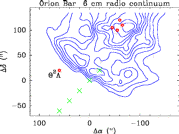
The Orion Bar has been observed in a number of molecular lines on 5 positions
across the ionization front (see Figure 1).
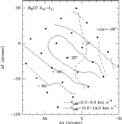
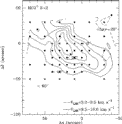
Also, a couple of maps have been made in millimeter lines of HCO+
and H2CO (Figure 2).
Table 1 lists all observed species.
Physical properties
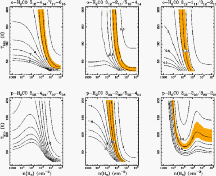
Using a statistical equilibrium excitation code we calculated line ratios
for a range in temperatures and densities
(Figure 3). Comparison with the
observations gives values for temperature and density.
As it turns out, the Orion Bar data cannot be fitted with one component.
The best fitting model is one with high density clumps (n(H2)=1E+6 cm-3)
embedded in low density interclump gas (n(H2)=3E+4 cm-3). The clumps
have a volume filling factor of 0.3 % but they contain 10 % of the gas.
Both components are found to have temperatures in the range 85 +/- 30 K.
Using these values of Tkin and n(H2), column densities were derived.
Those are listed in Table 1.
Geometry
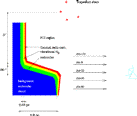
The variation in H2 column density (inferred from C18O) is most
easily interpreted as a variation in line-of-sight length through the PDR
since there is no evidence for variation in any of the other physical
parameters.
However, since this whole column exhibits PDR characteristics, the most likely
explanation is a geometrical one : at the extreme positions, the PDR is seen
face-on, whereas at the peak position it is seen edge-on
(Figure 4).
Chemistry
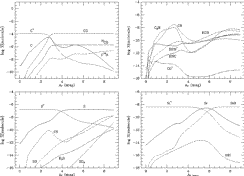
Chemical calculations have been performed using a one-dimensional code with
approx. 1200 reactions (see Jansen et al. 1995a).
These one-dimensional models are well suited for the face-on off-peak
positions (see Figure 5).
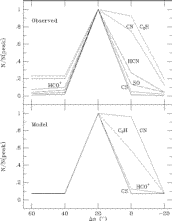
For the peak position, these model results were convolved with the derived
geometry. This simple approarch already yields a quite remarkable fit to the
observations (see Table 1 and
Figure 6).
To check this model, two-dimensional calculations were performed using the
actual geometry of the source. These models also included the clump
distribution.
References
- Hogerheijde, M.R., Jansen, D.J., Van Dishoeck, E.F., 1995,
A&A 294, 792
- Jansen, D.J., Van Dishoeck, E.F., Black, J.H., Spaans, M., Sosin, C.,
1995a, A&A, in press
- Jansen, D.J., Spaans, M., Hogerheijde, M.R., Van Dishoeck, E.F., 1995b,
A&A, 302, 223
- Jansen, D.J., 1995, PhD Thesis